
How to Evaluate Shopify Plus Developers: A Strategic Framework for 8-Figure Brands
There are dozens of Shopify Plus agencies claiming expertise, and on the surface, they all look capable. But for an 8-figure brand, the stakes of choosing the wrong partner go beyond frustrated emails.
At your scale, a bad deployment isn’t just a bug, it’s a P&L event.
The problem isn’t a lack of options; it’s that most evaluation criteria focus on surface-level credentials (themes and basic code) rather than the strategic capabilities that secure enterprise revenue. You don’t need a developer who can just “write code.” You need a partner who understands how that code impacts your inventory logic, your margins, and your customer lifetime value.
Here is how to cut through the noise and evaluate Shopify Plus partners based on what actually drives business outcomes at the enterprise level.
The Strategic Framework: What Actually Matters
1. Look for a Diagnosis-First Approach (The “Anti-Order Taker”)
Most developers operate as “order takers.” You ask for a feature, and they build it. While this feels efficient, it is dangerous for complex stacks. It leads to technical debt, plugin bloat, and conflicting logic that surfaces months later during high-traffic events.
Strategic developers diagnose before they build. They act like architects, not construction workers. They identify underlying architectural risks that cause recurring breakdowns rather than just patching symptoms.
How to test this: Ask potential partners: “How do you approach a project where we think we need Feature X, but aren’t 100% sure?”
- The Wrong Answer: “We can have that built in two weeks.”
- The Right Answer: “Why do you think you need Feature X? What metric are you trying to move? Let’s look at your current data flow to see if there’s a simpler, more stable way to achieve that goal.”
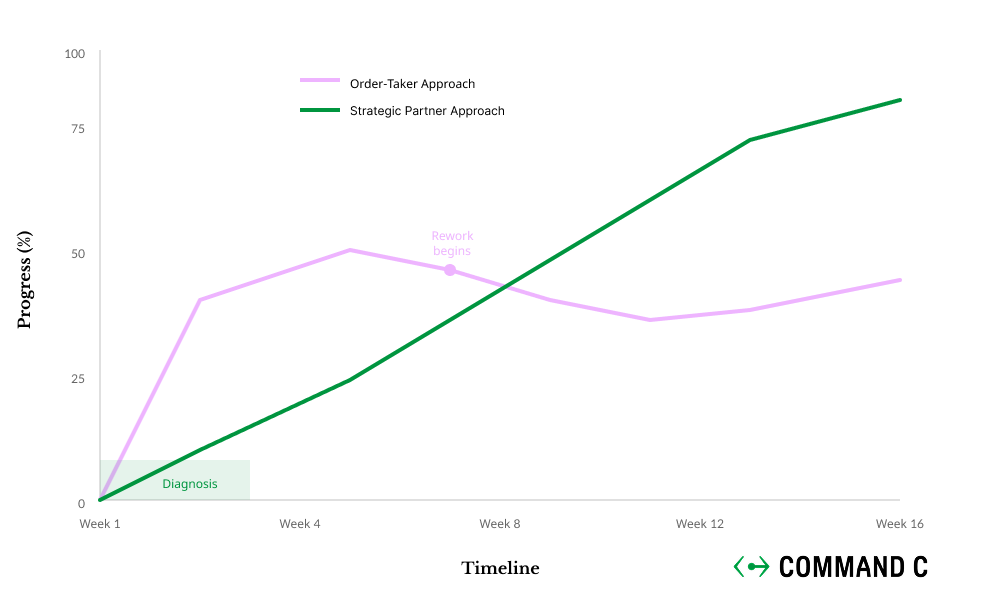
2. Evaluate Understanding of Enterprise Complexity
Scaling from $1M to $10M is hard; scaling from $10M to $50M requires an entirely different technical competency. 8-figure brands have requirements that basic Shopify developers simply haven’t seen enough of.
You need to validate that they understand the “invisible” layer of ecommerce: the data orchestration that happens between the storefront and the warehouse.
Ask about their specific experience with:
- Middleware Logic: Handling data orchestration between Shopify, ERPs (NetSuite, Microsoft Dynamics), and 3PLs to prevent overselling.
- High-Concurrency Load Testing: Not just “fast pages,” but checkout stability during 10x traffic spikes (BFCM/Flash Sales).
- Data Integrity: Managing complex migrations where customer history and loyalty points must remain intact.
3. Assess “Operational Fluency”
Poor communication is the #1 complaint in development partnerships, but for enterprise brands, “good communication” means more than just timely emails. You need developers who communicate like operators.
They should treat development as a business initiative, not a siloed task. When a technical decision is made, they should be able to articulate the impact on your Operations, Customer Support, and Marketing teams.
Test this during the interview: Do they ask about your operational workflows? Do they understand how a change in the checkout flow might impact your warehouse pick-and-pack times? If they only talk about Liquid code and APIs, they may lack the business context required to protect your bottom line.
The Landscape: Who Can Actually Support 8-Figure Growth?
At this stage of growth, you are likely debating between three core options. It is rarely a question of “hiring a freelancer”; it is a strategic choice between building internally or partnering externally.
Option A: The In-House Team
- Best for: Day-to-day maintenance, minor tweaks, and immediate proximity to the marketing team.
- The Risk: Tunnel Vision. In-house teams often lack exposure to the broader ecosystem. They only see your problems. They may not know that a new Shopify API update has broken 50 other stores, or that a specific app is causing latency across the industry. They are excellent for maintenance but often struggle with major architectural pivots.
Option B: The “Full-Service” Digital Agency
- Best for: Brands who want “one throat to choke” for ads, email, design, and dev.
- The Risk: Jack of all trades, master of none. These agencies often treat development as an upsell to their marketing services. Their developers are frequently juniors or outsourced, prioritizing “shiny” frontend features over backend stability.
Option C: The Strategic Technical Partner (Command C)
- Best for: Brands that treat technology as their competitive advantage.
- The Value: This model combines the stability of an in-house team with the “pattern recognition” of an agency. Because we work across dozens of high-volume stores, we spot trends, bugs, and opportunities months before an isolated in-house team would.
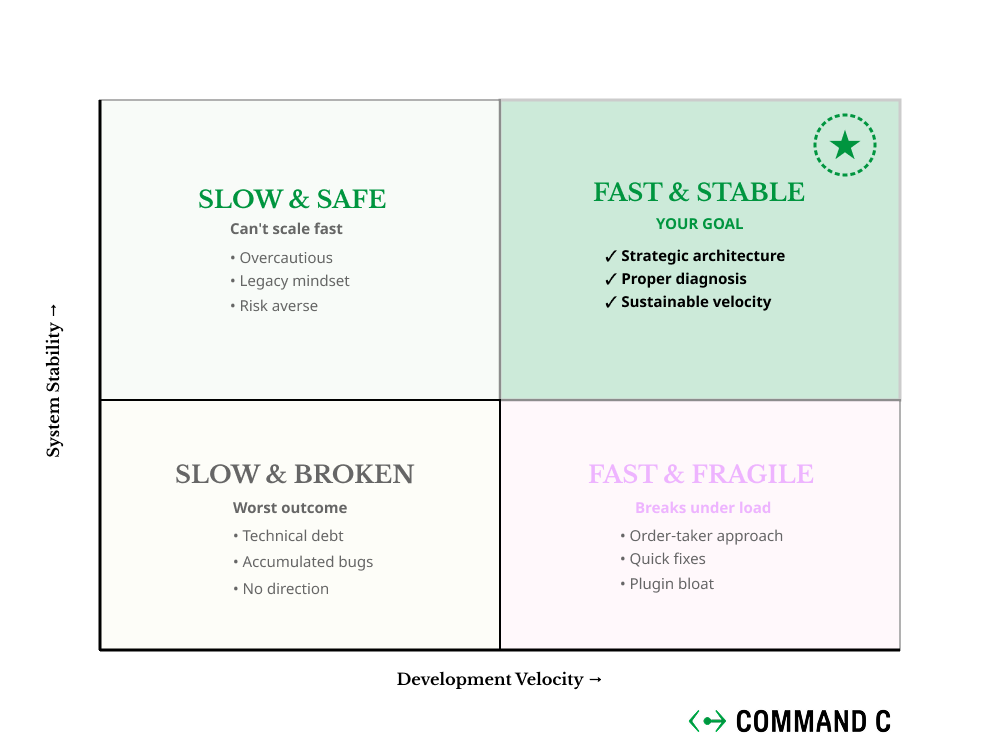
Command C: The “Stability-to-Scale” Approach
Most development teams ship fast but skip the root diagnosis. They patch symptoms, leaving your stack fragile.
Command C was built specifically for 8-figure ecommerce brands that need strategic partners, not just coding resources. We help brands transition from reactive firefighting to proactive growth through our proprietary Stability-to-Scale process.
Phase 1: Strategic Technical Roadmaps (Diagnosis)
Unlike developers who jump straight into code, we start with a comprehensive analysis of your ecosystem.
- Platform Fit & App Analysis: Auditing your 3rd party apps to reduce bloat and improve site speed.
- Operations Analysis: Reviewing inventory management, fulfillment workflows, and ERP connections.
- Outcome: A fully articulated roadmap that justifies every technical recommendation with a business case.
Phase 2: Enterprise-Grade Execution
Whether it is a complex migration from Magento/Salesforce to Shopify Plus, or a custom headless build, we prioritize Business Continuity.
- Parallel Building: We build your new infrastructure while your current site runs uninterrupted.
- Data Safety: We specialize in migrations that preserve complex data structures, ensuring you don’t lose years of customer history.
Phase 3: Long-Term Growth Partnership
We don’t disappear after launch. Our retainer model provides you with a dedicated squad—Project Manager, Tech Lead, and Developers—who maintain context on your business. This prevents the “re-education” cycle every time you need a new feature.
Red Flags: When to Walk Away
As you evaluate potential partners, be wary of these common warning signs:
1. The “Yes” (Wo)Men Be wary of teams that say “yes” to every request without pushback. A strategic partner should tell you “no” when a request threatens your site’s performance or ROI. If they promise “easy integration” without asking about your middleware or data schema, run.
2. Focus on Features over Outcomes Avoid developers who get excited about what they can build rather than why it should be built. If the conversation centers on cool animations rather than conversion rate, average order value (AOV), or operational efficiency, their priorities are misaligned.
3. Vague Approaches to Contingency Enterprise ecommerce involves inevitable complications. Experienced developers have established processes for “rollback” and “disaster recovery.” If a developer offers vague assurances that “everything will go smoothly” without a clear plan for when things go wrong, they are not ready for your scale.
Conclusion: Stop Hiring Vendors, Start Hiring Partners
At 8 figures, your technology stack is no longer just a “website”, it is the engine of your entire business.
When that engine stutters, you don’t need a mechanic who just replaces parts; you need an engineer who understands the whole machine. The difference between a vendor and a partner is simple: A vendor sells you hours of code. A partner sells you sleep at night.
Command C provides that peace of mind. By prioritizing diagnosis, stability, and operational fluency, we ensure your technology stops being a bottleneck and starts being the lever that propels you to 9 figures.
Ready to stabilize your stack? Book a Diagnosis Call with us