
Shopify Product Bundling Strategy: How 8 & 9-Figure Brands Build Profitable Bundle Programs
Most Shopify merchants approach product bundling as a quick win: install an app, create a few bundles, and hope for increased AOV. But for 8 & 9-figure brands, this surface-level approach often hits walls: bundle apps can’t handle complex inventory logic, pricing becomes unmanageable across thousands of SKUs, and integration with existing ERP systems breaks down.
The brands that see sustained success with bundling treat it as a strategic business architecture decision, not just a marketing tactic. They design bundle programs that work seamlessly with their fulfillment operations, customer data systems, and long-term growth plans.
Below, we’ll show you how sophisticated bundling strategy requires proper technical foundations, then walk through a framework that helps you build bundle programs that actually scale with your business.
The Strategic Foundation: Why Product Bundling Strategy Matters for 8 & 9-Figure Brands
Most 8 & 9-figure brands hit a wall with basic bundling apps when they try to scale beyond simple 2-product combinations across thousands of SKUs. What worked for a startup with 50 products becomes a liability for an established brand managing complex product catalogs, multiple inventory locations, and sophisticated fulfillment operations.
Effective bundling strategy requires alignment between your product catalog structure, inventory management systems, and customer experience goals. A bundle that looks simple on the frontend, say, a “Complete Skincare Routine”, might require coordination between your ERP system, 3PL fulfillment logic, subscription management platform, and customer data warehouse. When these systems aren’t aligned, bundle orders create operational chaos.
Without proper technical architecture, bundle programs create the exact problems they’re meant to solve: overselling bundled items when inventory tracking breaks, fulfillment errors when bundle logic doesn’t communicate properly with warehouse systems, and customer service headaches when bundle modifications don’t sync across platforms. These failures damage customer trust at the moment when you’re trying to build it.
The brands seeing double-digit AOV increases from bundling treat it as a core business capability, not a marketing add-on. They invest in the infrastructure needed to support complex bundling logic, just like they invest in any other system that directly impacts revenue.
Command C’s Approach: Strategic Bundling Architecture for Scale
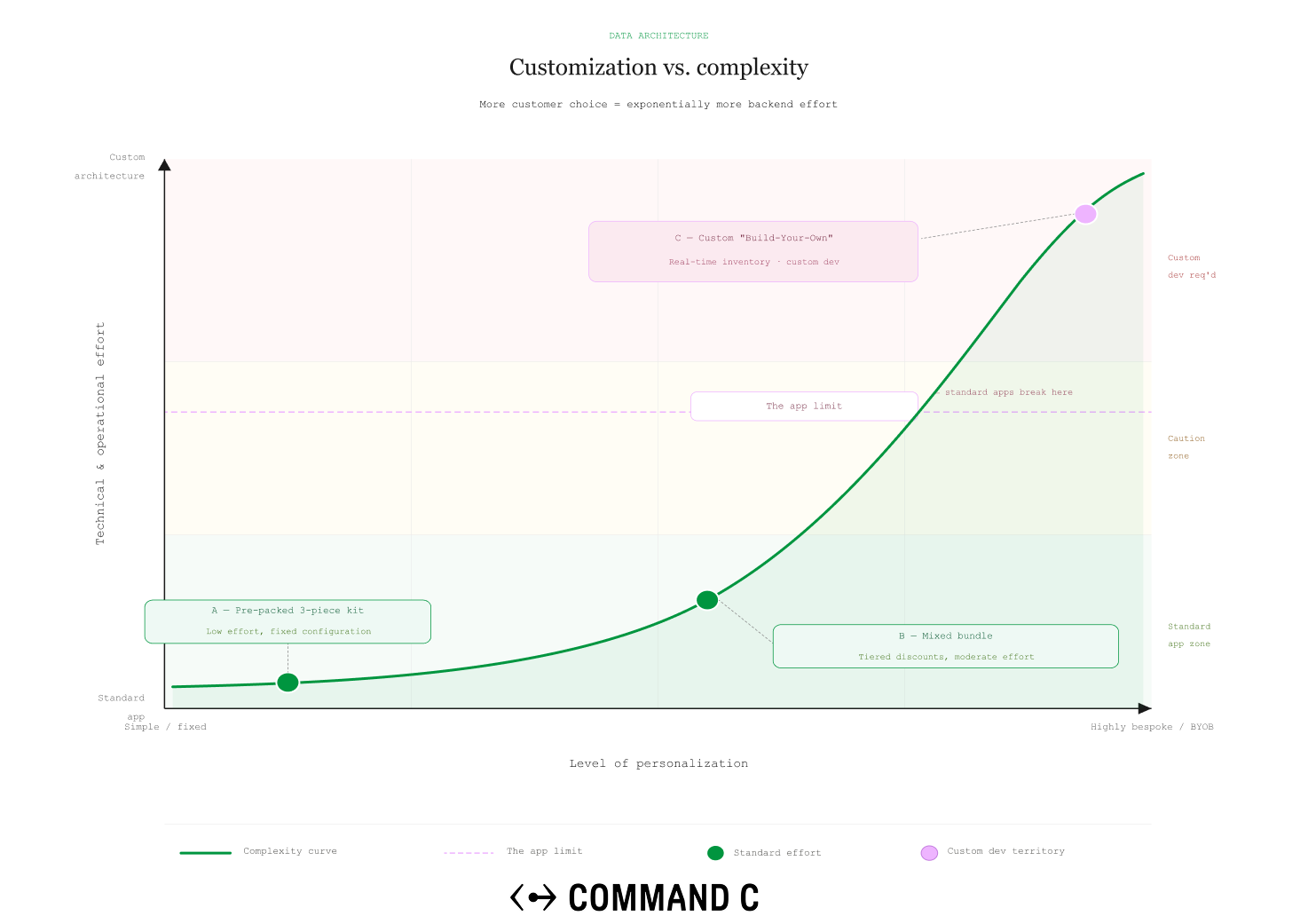
Generic bundling apps work for simple stores but break down when handling complex product relationships, multi-variant bundles, and high-volume inventory operations. They’re designed for the merchant with dozens of products, not thousands. When you’re managing complex product catalogs with seasonal variations, multi-location inventory, and sophisticated pricing rules, standard app solutions create more problems than they solve.
Strategic Technical Roadmaps for Bundle Programs
Before implementing any bundling strategy, we diagnose your current product data structure, inventory systems, and customer journey to identify the optimal bundling architecture. This is about understanding whether your current platform and integrations can support the bundling complexity your business needs.
Our roadmap process reveals whether your platform can support advanced bundling features like dynamic pricing based on customer segments, inventory-aware bundles that automatically adjust when components go out of stock, and custom bundle builders that scale across your entire catalog. We map out integration requirements with your ERP, 3PL, and customer data systems to ensure bundles work seamlessly across your entire operation.
The roadmap includes a phased implementation plan that lets you test bundling strategies before committing to major technical investments. You might start with curated bundles for your best-selling products, then expand to build-your-own functionality, and eventually implement dynamic bundle recommendations based on customer behavior data.
Enterprise-Grade Bundle Development
Custom bundle experiences go beyond simple app limitations. We build dynamic product recommendation engines that suggest complementary bundles based on customer purchase history and browsing behavior. Inventory-aware bundle suggestions automatically remove or substitute products when stock runs low, preventing the overselling issues that plague app-based solutions.
Build-your-own bundle functionality that scales to thousands of SKUs while maintaining accurate real-time inventory tracking requires sophisticated database architecture and caching strategies. When a customer creates a custom bundle, the system must check inventory across multiple locations, calculate dynamic pricing based on current promotions, and ensure the combination can be fulfilled efficiently.
Integration with existing business systems ensures bundle sales flow correctly through your ERP, update inventory across multiple locations, and trigger proper fulfillment workflows. Bundle orders shouldn’t require manual intervention or special handling—they should flow through your operations as seamlessly as single-product orders.
Bundle Performance Architecture
Bundle pages with dynamic pricing calculations and real-time inventory checks can significantly slow site performance without proper technical architecture. When customers are building custom bundles or viewing complex product combinations, each interaction can trigger multiple database queries and API calls. Without optimization, these features become conversion killers instead of conversion boosters.
We implement caching strategies and optimize database queries to ensure bundle pages load quickly even with complex pricing logic. Performance monitoring ensures your bundling features enhance rather than hinder the customer experience. A bundle page that takes five seconds to load defeats the purpose of increasing AOV.
Advanced Bundle Analytics and Optimization
Standard ecommerce analytics show bundle revenue, but sophisticated brands need deeper insights. Custom analytics implementation tracks bundle performance beyond basic revenue metrics: profitability by bundle type, customer lifetime value impact, and inventory turnover improvements. You need to know which bundles actually contribute to profit, not just gross revenue.
Data architecture that supports A/B testing of different bundle configurations, pricing strategies, and presentation formats lets you optimize bundle performance scientifically rather than through guesswork. Integration with your existing analytics stack ensures bundle performance data flows into your business intelligence systems alongside other key metrics.
Types of Product Bundles That Drive Results
Pure Bundles: When Exclusivity Creates Value
Pure bundles work best for curated experiences where the combination creates more value than individual items. Complete skincare routines, starter kits for new customers, or seasonal collections often perform better as pure bundles because they tell a complete story. The constraint forces customers to purchase the complete experience rather than cherry-picking individual products.
Pure bundles are particularly effective for new product launches where bundling with established products helps drive adoption. A new serum might struggle on its own but succeed when bundled with a popular moisturizer and cleanser as part of a “Complete Anti-Aging System.”
Pure bundles require careful inventory planning since component products can’t be sold separately to clear excess stock. If one component becomes overstocked, the entire bundle may need to be discontinued or repriced, which is why inventory forecasting becomes critical for pure bundle success.
Mixed Bundles: Flexibility With Strategic Pricing
Mixed bundles offer the most versatile approach, allowing customers choice while encouraging larger purchases through tiered discounting. Customers can purchase bundle components individually or together, but the bundle price creates a clear incentive for the larger purchase.
Pricing strategy typically offers 15-25% savings compared to individual purchases to create compelling value perception without destroying margins. The key is ensuring the discount feels significant to customers while maintaining profitability after accounting for potentially higher fulfillment costs.
Mixed bundles work particularly well for brands with deep product catalogs where customers have established preferences but might be willing to try new products at a discount. A coffee company might offer individual bags at full price while providing significant savings for customers who purchase three bags together.
Build-Your-Own Bundles: Personalization at Scale
Build-your-own bundles are technically complex but highly effective for brands with diverse product lines where customers have specific preferences or needs. The customization capability can significantly increase conversion rates by giving customers control over their purchase while still encouraging larger order values.
The technical challenge lies in sophisticated inventory management to prevent overselling when customers create custom combinations. If Bundle A uses Product X and Bundle B also uses Product X, the system must track both individual and bundle inventory in real-time to avoid overselling Product X through bundle combinations.
Build-your-own bundles perform best when limited to curated product sets rather than entire catalogs to avoid decision paralysis. A vitamin company might allow customers to build custom packs from 20 core supplements rather than from their entire 200-product catalog.
Cross-Category Bundles: Complete Customer Solutions
Cross-category bundles combine products from different categories to solve complete customer problems rather than just moving inventory. These strategic bundles often convert at higher rates because they provide comprehensive solutions customers didn’t realize they needed.
A fitness brand might bundle workout equipment with nutritional supplements and training guides, creating a complete fitness solution that’s more valuable than any individual component. The key is understanding customer use cases deeply enough to identify natural product combinations that enhance the overall experience.
Cross-category bundles require sophisticated understanding of customer journey and behavior data to identify which combinations actually provide value versus those that feel forced or artificial.
Subscription Bundles: Predictable Revenue Through Recurring Value
Subscription bundles create ongoing customer relationships while providing predictable revenue streams for better business planning. The recurring nature allows for more complex bundle logic, including seasonal variations, customer preference learning, and automatic product substitutions.

Technical implementation requires integration between bundling logic and subscription management platforms to handle product substitutions when items go out of stock, pricing changes for existing subscribers, and customer modifications to their recurring bundles.
Subscription bundles work best when bundle contents can evolve over time based on customer preferences and seasonal availability. A coffee subscription might start with customer-selected blends but evolve to include new releases and seasonal specialties based on the customer’s rating history.
Bundle Pricing Psychology and Strategy
Value Perception Optimization
Customers perceive bundles as better deals even with modest 10-15% discounts because the combined price feels like a larger purchase decision with more substantial savings. The psychology works because customers anchor on the individual prices they’ve seen, making the bundle savings feel more significant than they actually are mathematically.
Presenting savings in dollar amounts rather than percentages often increases conversion rates for higher-value bundles. “Save $47” feels more substantial than “Save 15%” for a $300 bundle, even though the percentage clearly shows the relative value.
Bundle pricing should account for customer acquisition costs, lifetime value, and inventory carrying costs, not just individual product margins. A bundle that breaks even on the first purchase might be highly profitable if it increases customer lifetime value or helps move slow-moving inventory.
Tiered Bundle Strategies
Progressive discounts encourage customers to add additional items and increase average order values. The tier structure works by making each additional item feel like an increasingly better deal: buy 2 save 10%, buy 3 save 20%.
Tier structures work best when the additional items have high margins or help move slower inventory. The psychology depends on the customer feeling like they’re getting a better deal with each additional item, but the economics require that higher tiers still maintain acceptable profitability.
Clear communication of tier benefits prevents customer confusion and reduces cart abandonment. Customers should immediately understand what they need to add to reach the next tier and what benefit they’ll receive.
Dynamic Bundle Pricing
Advanced implementations can adjust bundle prices based on inventory levels, customer segment, or seasonal demand. Slow-moving inventory can be included in bundles at deeper discounts, while high-demand products might be bundled with smaller discounts to maximize profitability.
Dynamic pricing requires sophisticated technical architecture to maintain pricing consistency across customer touchpoints and prevent pricing errors. The system must ensure that a customer who adds a bundle to cart sees the same price at checkout, even if inventory levels or other factors change during their session.
Dynamic pricing works best for brands with large catalogs where manual pricing management becomes unsustainable. The automation allows for more responsive pricing strategies while reducing the operational overhead of constantly adjusting bundle prices.
Implementation Approaches: Apps vs Custom Development
When Shopify Apps Are Sufficient
Basic bundle needs with straightforward product relationships and simple pricing structures can be handled effectively by established apps. If you’re bundling products within the same category, offering simple percentage discounts, and managing under 1,000 SKUs, apps like Bold Bundles or Bundle Builder provide adequate functionality without custom development costs.
Apps work well for testing bundle concepts before investing in custom development. You can validate customer demand, test pricing strategies, and identify operational challenges using app-based solutions before committing to expensive custom development.
The app approach remains suitable for brands with simple inventory management needs, straightforward fulfillment processes, and limited integration requirements with external systems.
When Custom Development Is Necessary
Complex product catalogs with thousands of variants require custom bundle logic that apps can’t handle efficiently. When you’re managing seasonal products, multi-location inventory, complex pricing rules, and sophisticated customer segmentation, generic apps become bottlenecks rather than solutions.
Integration requirements with existing ERP systems, custom PIM platforms, or proprietary business logic often exceed app capabilities. If your bundle strategy needs to coordinate with existing business systems or requires data flows that aren’t supported by standard apps, custom development becomes necessary.
High-volume operations need performance optimization and advanced caching that generic apps don’t provide. When bundle pages are generating thousands of database queries or taking multiple seconds to load, custom solutions optimized for your specific use case become essential for maintaining conversion rates.
Hybrid Approaches for Growing Brands
Start with app-based bundling for market validation, then migrate to custom solutions as complexity increases. This approach allows you to prove bundle demand and refine your strategy before investing in expensive custom development.
The gradual implementation approach lets you test different bundle types and pricing strategies while your technical team plans the eventual custom implementation. You can identify which bundles perform best, what operational challenges emerge, and what technical requirements matter most for your specific business.
When planning platform migrations, consider long-term bundling requirements early in the process to avoid rebuilding bundle functionality later. Bundle logic that works on your current platform might not transfer cleanly to a new platform, especially if you’ve customized extensively.
Measuring Bundle Success: Beyond Revenue Metrics
Profitability Analysis
Bundle success should be measured by profit contribution, not just revenue increase, since bundling often involves discounting. A bundle that increases AOV by 30% but reduces margins by 40% isn’t actually improving business performance—it’s trading profit for vanity metrics.
Track inventory turnover improvements for slower-moving products included in bundles. One of the strategic benefits of bundling is moving inventory that might otherwise require markdowns or write-offs. Measure whether bundled slow-movers are turning over faster and contributing to overall inventory efficiency.
Monitor fulfillment cost changes since bundle orders may have different shipping and handling requirements. Bundle orders might be more expensive to pick and pack, or they might improve shipping efficiency by increasing order values above free shipping thresholds.
Customer Behavior Impact
Measure customer lifetime value changes for bundle purchasers versus single-item buyers. Bundle customers often have higher lifetime values because they’ve made a larger initial commitment and experienced more of your product range, but this should be measured rather than assumed.
Track repeat purchase rates and customer retention improvements from bundle introductions. Customers who purchase bundles might be more likely to reorder because they’ve experienced multiple products and understand how they work together.
Analyze customer journey changes to understand whether bundles accelerate purchase decisions or change browse-to-buy patterns. Some bundles reduce decision-making time by providing curated solutions, while others might increase consideration time as customers evaluate more complex options.
Operational Efficiency Gains
Monitor inventory management improvements beyond just turnover rates. Effective bundles can reduce carrying costs for slow-moving items, improve demand forecasting by creating more predictable product combinations, and simplify purchasing decisions by establishing successful product relationships.
Track fulfillment efficiency changes to understand the operational impact of bundle orders. While bundle orders may be more complex to pick, they can improve warehouse productivity by increasing average order values and reducing the number of shipments required to achieve the same revenue.
Measure customer service impact to ensure that bundle complexity isn’t creating support burdens. Well-designed bundles should reduce support inquiries about product compatibility and usage, but poorly implemented bundles can create confusion and increase support costs.
Alternative Bundling Solutions to Consider
Shopify Native Bundles
Shopify’s built-in bundling functionality handles basic use cases without additional app costs or third-party dependencies. The native solution works well for simple product combinations with straightforward pricing and inventory management needs.
The limitation lies in advanced features: native bundles lack dynamic pricing capabilities, complex inventory management across variants, and sophisticated analytics that established brands typically require. It’s suitable for brands testing bundling concepts or with very straightforward bundling requirements.
Bold Bundles
Bold Bundles provides comprehensive functionality including infinite product options, complex pricing rules, and advanced inventory management features. The app handles more sophisticated use cases than basic solutions while maintaining easier implementation than custom development.
Strong integration with other Bold apps creates advantages for brands already using their ecosystem for subscriptions, upsells, or other functionality. The integrated approach can provide better data consistency and simplified management across multiple revenue optimization tools.
The app can handle moderately complex scenarios but may struggle with very high-volume operations or highly customized business requirements that exceed its built-in functionality.
ReCharge Bundles
ReCharge offers specialized bundling functionality designed specifically for subscription-based businesses, with advanced features for managing recurring bundle deliveries and customer bundle customization over time.
The platform includes sophisticated customer portal functionality that allows subscribers to modify their bundles, pause subscriptions, and manage recurring bundle deliveries. This capability is essential for subscription businesses where customer control reduces churn.
ReCharge bundling requires commitment to their subscription platform, making it most suitable for brands where subscription revenue represents a significant portion of their business model.
Custom Enterprise Solutions
Large retailers with unique business requirements often build proprietary bundling systems integrated with their specific ERP, PIM, and customer data platforms. Custom solutions provide maximum flexibility but require significant development investment and ongoing maintenance resources.
Consider custom development when bundling becomes a core competitive differentiator requiring functionality that no existing solution provides. This typically applies to brands with highly complex product catalogs, unique business models, or integration requirements that exceed standard solutions.
The investment makes sense when bundle revenue represents a significant portion of total sales and the operational efficiencies from perfect integration justify the development and maintenance costs.
Bundle strategy for 8 & 9-figure brands is about creating integrated customer experiences that align with your operational capabilities and long-term growth plans, as much as it’s about increasing AOV. The brands that succeed treat bundling as a business architecture decision requiring proper technical foundation, not a marketing tactic requiring only creative thinking.
When approached strategically, product bundling becomes a sustainable competitive advantage. When implemented poorly, it creates operational headaches that cost more than the additional revenue they generate.
If you’re ready to develop a bundling strategy that scales with your business rather than against it, our Strategic Technical Roadmap process can help you identify the optimal approach before you invest in implementation. We’ll assess your current technical infrastructure, business requirements, and growth plans to design a bundling architecture that supports your long-term success.