
Diagnose First, Plan Second: A Technical Approach to Ecommerce Technology Roadmapping
Most ecommerce technology roadmaps start with high-level planning. This works for small shops, but for 8-figure brands, it leads to:
- Underperforming Migrations: Moving data without cleaning it first.
- Broken Integrations: APIs that fail under peak traffic loads.
- Compounding Technical Debt: Quick fixes that become permanent problems.
The problem with planning-first roadmaps is they skip the most critical step: understanding what’s actually happening under the hood. Without diagnosing your current technical architecture, data flows, and operational bottlenecks, even the best strategic plans become guesswork.
Command C’s approach flips this process. We diagnose before we build, ensuring your technology roadmap addresses root causes rather than symptoms. This creates a foundation that supports growth without fear of collapse, turning development from a bottleneck into a growth engine.
What is an Ecommerce Technology Roadmap?
An ecommerce technology roadmap is a strategic document that maps out the technical decisions, platform migrations, and infrastructure investments needed to support business growth over 12-24 months. Unlike generic business roadmaps, technology roadmaps for ecommerce must account for complex integrations between platforms, ERPs, 3PLs, and marketing systems.
Most roadmaps fail because they focus on features and timelines rather than diagnosing the underlying technical architecture and operational bottlenecks. Teams jump into planning mode without understanding why their current systems are breaking down or where the real friction points exist.
Successful roadmaps serve as both strategic planning tools and technical blueprints that guide development partnerships and budget allocation. They answer critical questions like: Which platform can handle our operational complexity? How do we migrate without losing revenue? What integrations are essential versus nice-to-have?
For 8-figure brands, these aren’t just technical documents—they’re business survival plans that determine whether growth accelerates or stalls.
Common Mistakes in Ecommerce Technology Roadmaps
Here’s the pattern we see repeatedly: A brand decides they need a new platform or major technical overhaul. They research options, create timelines, define requirements, and start building. Six months later, they’re over budget, behind schedule, and dealing with problems they never anticipated.
The issue isn’t poor execution—it’s poor diagnosis.
Most dev teams ship fast but skip the root diagnosis. They patch symptoms instead of solving causes, so issues resurface and your stack keeps breaking. Without understanding the technical debt, integration failures, and operational bottlenecks that created the current problems, roadmaps become expensive guesswork.
This is why Command C starts every engagement with comprehensive technical analysis. We diagnose before we build, communicate like operators, and act like an extension of your team. The result is a roadmap that fixes root problems rather than creating new ones.
Command C’s Strategic Technical Roadmap Process
Why We Created the Strategic Technical Roadmap
Most development teams jump straight into building without understanding the root technical problems, leading to expensive rebuilds and continued operational friction. Generic roadmap frameworks don’t address the specific challenges 8-figure brands face: technical debt, platform limitations, and complex operational requirements.
Command C’s process dramatically improves the likelihood of selecting the right platform and extensions by diagnosing first, then planning. This approach prevents the costly mistakes that plague most technology initiatives.
Our Two-Faceted Analysis Approach
Ecommerce Analysis
The technical side focuses on platform architecture and digital infrastructure:
- Platform fit assessment evaluates current functionality against business requirements rather than wishlist features. We examine how your existing platform handles product catalog complexity, pricing rules, inventory management, and customer data—not just surface-level functionality.
- App and extension analysis identifies which tools actually solve operational problems versus create technical debt. Many brands accumulate dozens of apps over time, creating integration conflicts and performance issues that compound during migrations.
- Feature estimation and prioritization based on business impact, not development ease. We map features to specific operational workflows and revenue drivers, ensuring development resources focus on what actually moves the needle.
- Comprehensive specifications document prevents scope creep and ensures alignment between technical requirements and business objectives throughout the project lifecycle.
Operations Analysis
The operational side examines how technology integrates with business workflows:
- Deep dive into inventory management, order fulfillment, purchasing workflows, and sales channel complexity. We map how data flows between systems and where manual workarounds indicate integration failures.
- Stakeholder interviews uncover hidden requirements and operational pain points early in the process. Different departments often have conflicting needs that surface late in projects without proper discovery.
- Integration mapping identifies how systems need to communicate and where data flows break down. This includes ERP connections, 3PL integrations, marketing automation, and accounting systems that must work seamlessly.
- Accounting and reporting evaluation ensures new systems support existing business processes without creating additional manual work or compliance issues.

What You Get: A Comprehensive Technical Roadmap
The outcome is a fully-articulated roadmap that addresses:
- MVP definition includes platform fit analysis, necessary apps/extensions, and critical third-party integrations. This prevents feature creep while ensuring core functionality works reliably.
- Budget and timeline projections with phased approaches to meet market deadlines and financial constraints. We identify which elements are critical for launch versus post-launch optimization.
- Stakeholder needs assessment ensures all operational requirements are addressed in the technical solution, preventing post-launch surprises that derail adoption.
- Long-term foundation planning supports business growth without requiring constant rebuilds. We design for scalability from day one rather than patching limitations later.
- Technical limitations analysis prevents costly surprises during implementation by identifying platform constraints and integration challenges before development begins.
The 3 Stages of Ecommerce Maturity
Generic roadmap advice assumes all businesses are at the same technical maturity level. But 8-figure brands exist in one of three distinct phases, each requiring different roadmap priorities and development approaches.
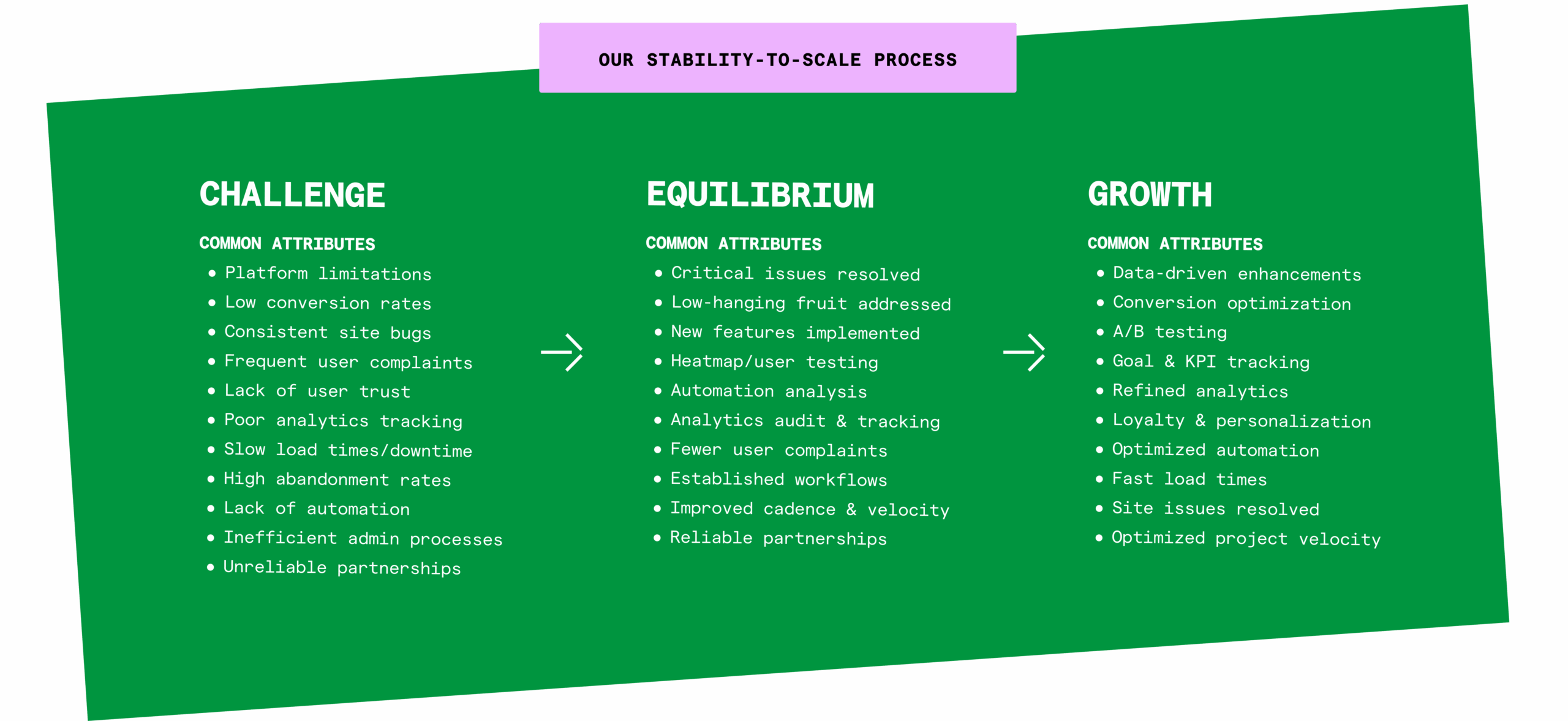
Challenge Phase: When Your Tech Stack is Fighting You
Platform instability, technical debt, and unreliable development support signal you’re in the Challenge phase where immediate stabilization is the priority. Your site breaks regularly, integrations fail, and teams spend more time firefighting than building.
Roadmaps in this phase focus on aggressive, front-loaded development to address critical blockers rather than incremental improvements. Success requires making hard choices about what to fix versus what to rebuild entirely.
Success metrics shift from growth targets to operational predictability and reduced firefighting. Teams measure progress by decreased emergency support tickets, improved site uptime, and restored confidence in the technical foundation.
Development velocity depends on both technical capacity and executive responsiveness to rapidly changing priorities as hidden problems surface during remediation efforts.
| Phase Name | Symptoms | Success Metric |
|---|---|---|
| Challenge Phase | • Migration to a new ecommerce platform • Duct-taped systems from legacy builds • Bugs, instability, or launch risk • An unreliable or overly design-led dev team |
• Slow load times • Low conversion rate • High cart abandonment • Consistent site bugs |
| Equilibrium Phase | • A reliable, well-documented tech foundation • Proactive support, not reactive fixes • Breathing room to plan, build, and ship with confidence |
• Fewer user complaints • Fewer bugs |
| Growth Phase | • Improving conversions • Optimized project velocity • Adding features that unlock real business impact |
• Fast load times • Improved conversion rates |
Equilibrium Phase: Building on Stable Ground
Once critical issues are resolved, roadmaps can shift toward strategic initiatives like conversion optimization, analytics frameworks, and UX improvements. The immediate fires are out, but growth requires proactive development rather than reactive fixes.
This phase requires careful prioritization since fewer obvious problems exist and teams must balance maintenance with growth initiatives. It’s tempting to coast when things feel stable, but stability doesn’t automatically translate to growth without strategic direction.
Risk lies in complacency—stability doesn’t automatically translate to growth without strategic direction. Many brands plateau in this phase because they lack frameworks for identifying and executing growth opportunities.
Roadmaps should include proactive technical debt reduction and cross-team alignment around shared KPIs that connect technical improvements to business outcomes.
Growth Phase: Converting Stability into Competitive Advantage
Development resources shift from reactive maintenance to proactive value creation through advanced CRO programs, personalization engines, and operational automation. Technology becomes a profit center rather than cost center.
Roadmaps focus on compounding gains where multiple optimization efforts reinforce each other: higher conversions enable larger ad spends, which generate more data for personalization, which improves conversions further.
Success requires sustained testing frameworks, AI-driven optimization, and deep integration across all business systems. Teams can execute sophisticated strategies because the technical foundation supports rapid experimentation.
Growth phase roadmaps enable pulling multiple levers simultaneously: higher conversions, larger baskets, improved retention, and reduced operational costs through automation and optimization.
Selecting the Right Platform for Your Roadmap
Platform selection determines every other technical decision in your roadmap, making it the most critical choice for 8-figure brands. Get this wrong, and every subsequent development project becomes more expensive and complex.
Most businesses underestimate platform requirements by focusing on current needs rather than operational complexity and growth trajectory. They evaluate platforms like shopping for software rather than architecting technical infrastructure.
Shopify Plus, BigCommerce, and Magento each serve different operational models, and misalignment leads to expensive migrations later. A brand with complex pricing rules and ERP integrations will struggle on Shopify Plus, while a simple DTC brand might find Magento overkill.
Command C’s platform analysis evaluates:
- Product catalog complexity and variant management requirements
- Multi-location inventory and fulfillment workflows
- Internationalization needs including currency, tax, and shipping rules
- Custom pricing rules and B2B functionality requirements
- ERP integration complexity and real-time data synchronization needs
- Future workflow demands based on business growth plans
The right platform reduces technical debt and development friction while the wrong platform creates years of workarounds and limitations. This single decision impacts development velocity for the entire technology roadmap.
Integration Architecture: Connecting Your Ecommerce Ecosystem
Modern ecommerce operations depend on seamless data flow between platforms, ERPs, 3PLs, marketing tools, and analytics systems. When integrations fail, the entire business feels the impact through inventory discrepancies, order processing delays, and manual workarounds.
Integration failures are the leading cause of operational inefficiency for 8-figure brands. Customer service can’t access order history, inventory numbers don’t match across systems, and marketing automation breaks when customer data doesn’t sync properly.
Command C maps complete data workflows to identify where information breaks down and creates manual workarounds. This includes tracking how product data flows from ERP to ecommerce platform, how order information reaches fulfillment systems, and how customer data syncs across marketing tools.
Successful integrations require understanding API limitations, webhook reliability, data transformation needs, and failover protocols. Many platforms promise easy integrations but struggle with the data volume and complexity that 8-figure brands require.
Our roadmaps include integration testing strategies that prevent launch-day surprises and ensure business continuity during migrations. We identify which integrations are critical for day-one functionality versus which can be phased in post-launch.
Migration Planning: Protecting Revenue During Technical Transitions
Data migration represents the highest risk element of any technology roadmap. When migrations fail, brands lose customer data, order history, and SEO rankings that took years to build.
Command C’s migration process preserves business continuity through parallel building, comprehensive data mapping, and staged rollouts. We build the new platform alongside the existing one, allowing for thorough testing before switching over live traffic.
Critical elements include:
- Gift card transfers that preserve customer balances and promotional commitments
- Customer account continuity so existing customers can access order history and saved information
- Order history preservation for customer service and analytics continuity
- SEO equity protection through proper redirect mapping and URL structure planning
Our roadmaps include delta migration strategies for handling changes that occur during build periods and recovery protocols for unforeseen issues. We plan for the inevitable complications that arise when moving years of operational data.
Successful migrations require cross-functional ownership spanning technical, business, and customer service teams with clear accountability for different migration elements and rollback procedures if issues arise.
Alternative Approaches: DIY vs. Agency vs. Strategic Partnership
DIY Technology Roadmapping
Internal teams often lack the cross-platform expertise needed to evaluate complex technical tradeoffs. They understand the current business deeply but may not have experience with multiple platform migrations or integration architectures.
DIY approaches frequently underestimate integration complexity and migration risks, leading to expensive course corrections mid-project. Teams discover platform limitations too late in the process to change course without significant delays.
This approach works best for simple operational models but becomes overwhelming for 8-figure brands with established technical debt, complex integrations, and sophisticated operational requirements.
Traditional Development Agencies
Most agencies focus on design and feature delivery rather than strategic technical architecture. They excel at building what you ask for but may not challenge assumptions or recommend better approaches.
Agency relationships typically end after project completion, leaving brands without ongoing technical guidance as business needs evolve. There’s no incentive to design for long-term maintainability or scalability.
Limited experience with complex migrations and enterprise-level operational requirements means agencies often underestimate project complexity and struggle with integration challenges that 8-figure brands face.
Command C’s Strategic Partnership Model
A long-term dev engagement allows deep understanding of business operations and strategic contribution beyond tactical execution. We learn how your business actually works and can recommend improvements based on operational knowledge.
Ongoing support prevents technical debt accumulation and provides proactive guidance as business needs evolve. We’re invested in long-term success rather than project completion.
Our partnership model costs significantly less than in-house technical teams while providing senior-level expertise across disciplines. You get access to platform specialists, integration architects, and strategic planners without the overhead of full-time employees.
Strategic alignment ensures development roadmaps support business objectives rather than just technical requirements. We act as an extension of your team, not just a vendor taking orders.
How to Build Your Ecommerce Technology Roadmap
Creating an effective ecommerce technology roadmap starts with honest assessment of your current technical maturity. Are you fighting fires daily, maintaining stability, or ready to optimize for growth?
Command C’s Strategic Technical Roadmap service provides the diagnostic foundation that makes roadmapping effective. We examine your current technical architecture, operational workflows, and business objectives to create a roadmap that addresses root causes rather than symptoms.
The process takes 2-3 weeks and delivers a comprehensive blueprint for technical decisions, platform migrations, and development priorities that support scalable growth rather than continued firefighting.
Get in touch to see how we help brands move from reactive technical management to strategic technology roadmaps that unlock growth.