
Is Headless Shopify Worth the Investment? A Technical Leader’s Guide to the Decision
Headless Shopify promises unlimited customization, lightning-fast performance, and complete control over your customer experience. But for many 8 & 9-figure brands, the reality is more complex than the marketing suggests.
Most agencies and developers will immediately pitch headless as the solution to every platform limitation, but that approach often leads to over-engineered systems, budget overruns, and technical debt that’s worse than what you started with.

The real question isn’t whether headless Shopify has impressive capabilities, it’s whether those capabilities solve the specific problems holding your business back, and whether the investment delivers returns that justify the complexity.
We’ve guided dozens of scaling brands through this exact decision. What we’ve learned is that headless architecture can be transformative when it addresses actual bottlenecks, but it becomes expensive complexity when it’s implemented for the wrong reasons.
What Is Headless Shopify (And Why It Matters for Scaling Brands)
Headless Shopify separates your storefront (what customers see and interact with) from Shopify’s backend commerce engine. You get complete control over the customer experience while leveraging Shopify’s proven infrastructure for orders, inventory, and payments.
Traditional Shopify themes can make certain highly interactive experiences more difficult to implement efficiently because you’re working within Shopify’s theme architecture and app ecosystem. Want a custom product configurator? You’re fighting theme limitations. Need advanced filtering that doesn’t slow down page speed? You’re stuck with what apps can deliver within theme constraints.
With headless, you can build custom storefronts using modern frameworks like React or Next.js while Shopify handles the commerce complexity behind the scenes. This separation means your developers can create exactly the experience you envision without worrying about breaking checkout flows or inventory management.
This architecture becomes valuable for 8 & 9-figure brands when theme limitations start constraining growth, performance, or competitive differentiation. But it’s not automatically better, it’s a tool that solves specific problems.
| Feature | Optimized Traditional (Liquid) | Headless Shopify (Hydrogen/Next.js) |
|---|---|---|
| Speed (Lighthouse) | Fast with proper optimization | Potentially very fast with engineering investment |
| Maintenance | Low (Handled by Shopify) | High (Requires Engineering Team) |
| App Integration | Plug-and-Play | Custom API Engineering |
| Best For | Scaling Brands ($10M–$50M) | Enterprise/Omnichannel |
Why Most Headless Shopify Projects Fail
Many agencies pitch headless as a silver bullet without diagnosing whether your actual bottlenecks require headless architecture to solve. We’ve seen brands spend six figures on headless implementations to fix problems that could have been resolved with theme optimization and app consolidation.
Teams jump into headless implementations without understanding the ongoing development resources and maintenance complexity required. Unlike traditional Shopify where marketing teams can update content independently, headless storefronts often require CMS configuration or developer involvement depending on the architecture. That flexibility comes with dependency.
Without proper planning, headless projects often result in over-engineered systems that cost more to maintain than traditional Shopify setups. One client came to us after their headless project had been in development for eight months with no launch date in sight. The agency had built custom solutions for functionality that Shopify handles automatically, creating a system that was both fragile and expensive.
Command C’s Strategic Technical Roadmap Process
Before recommending any architectural approach, we conduct comprehensive discovery to understand your current platform limitations, business goals, and team capabilities. Most dev teams skip this step and jump straight to building, but that’s how you end up solving the wrong problems.
Our roadmap process evaluates whether headless actually solves your specific problems or if optimized traditional Shopify would deliver better ROI. We map current performance bottlenecks, catalog your existing technical debt, and identify which constraints are architectural versus operational.
We also map out implementation complexity, ongoing maintenance requirements, and resource needs so you can make informed decisions rather than following trends. This includes honest conversations about whether your team is prepared for the ongoing development partnership that headless requires.
When headless is the right choice, our enterprise-grade migration methodology prevents the data migration pitfalls and integration failures that plague most headless projects. We build implementations with long-term stability in mind, avoiding the technical debt that comes from rushing to market.
When Headless Shopify Is Worth the Investment
Your current platform limitations are directly impacting revenue through poor performance, conversion bottlenecks, or inability to implement required features. If your site speed is costing you conversions and theme-level optimizations haven’t resolved it, headless architecture can deliver the performance gains you need.
You need advanced customization for complex product configurators, subscription logic, or multi-market experiences that Shopify themes can’t support. We worked with a furniture brand that needed customers to visualize custom configurations in real-time. Traditional themes couldn’t handle the interactive complexity without significant performance degradation.
Site performance is affecting your SEO rankings and conversion rates, and you have the technical resources to maintain a custom frontend. Headless can deliver exceptional Core Web Vitals, but only if your team can optimize and maintain the custom code ongoing.
You’re expanding into omnichannel experiences (mobile apps, in-store displays, voice commerce) that require API-first architecture. Headless Shopify’s Storefront API becomes valuable when you need the same commerce data feeding multiple touchpoints.
Your team has dedicated developer resources or budget for ongoing technical partnerships to maintain the headless implementation. This isn’t optional. Headless storefronts require continuous technical attention that traditional themes don’t.
When Traditional Shopify Is the Better Choice
Your current conversion and performance issues can be solved through theme optimization, app consolidation, or technical debt cleanup. We’ve seen brands achieve major speed improvements just by auditing their app stack and removing conflicting scripts.
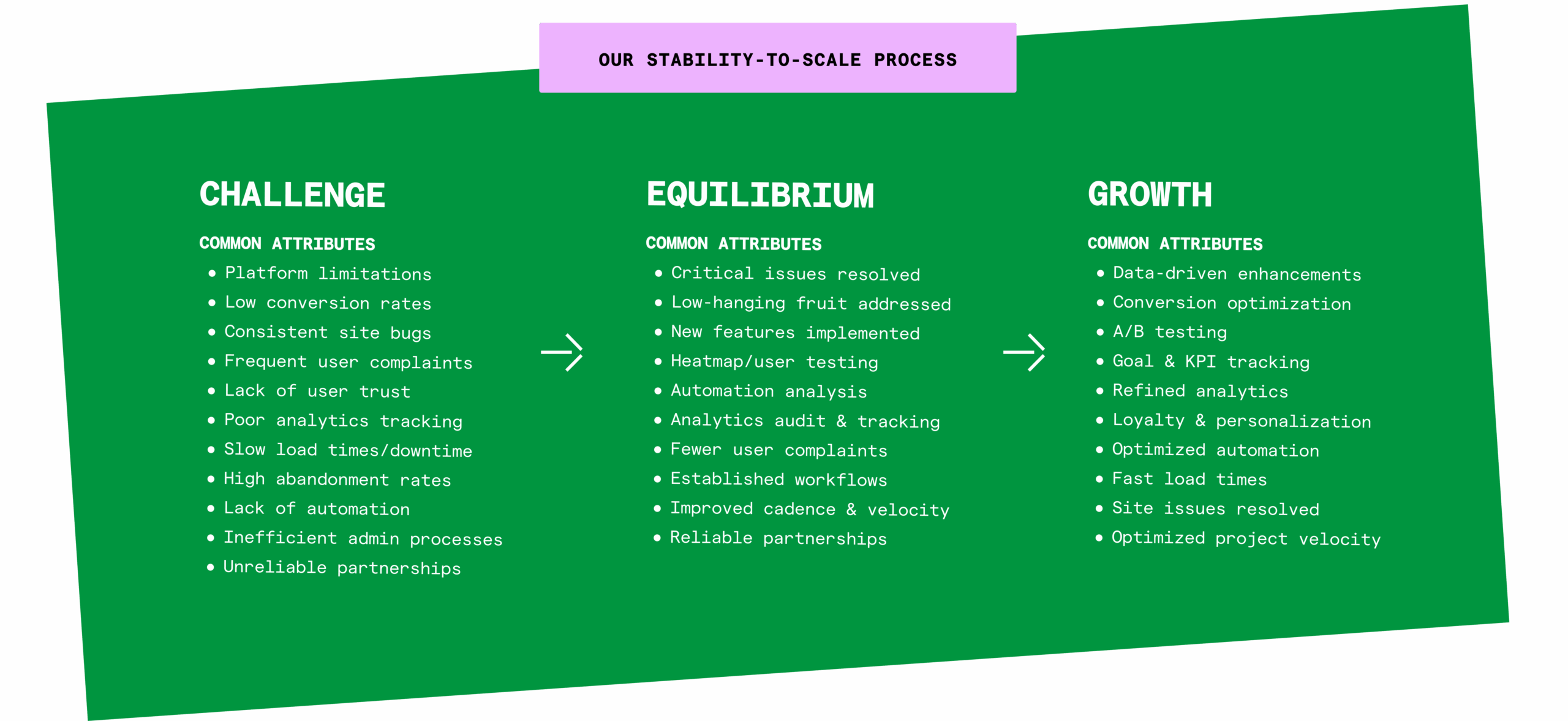
You’re in what we call the “Challenge” phase of our Stability-to-Scale Process: where stabilizing your existing platform would deliver faster ROI than architectural changes. If your team is constantly firefighting technical issues, headless complexity will make things worse, not better.
Your team lacks the technical resources for ongoing headless maintenance, and you’d prefer marketing teams to manage content updates independently. Traditional Shopify’s strength is operational simplicity. Headless trades that simplicity for flexibility.
Budget constraints make the higher upfront and ongoing costs of headless implementations impractical for your current growth stage. Headless makes sense when the performance and customization gains directly translate to revenue that justifies the investment.
Your competitive advantages come from product quality, customer service, or operations rather than unique digital experiences. Not every brand needs a custom frontend. Some of the highest-converting sites we’ve worked with use optimized traditional themes.
The Hidden Costs of Headless Shopify
Initial development costs typically run 3-5x higher than theme customizations due to custom frontend development and API integration complexity. You’re not just paying for design and UX. You’re paying for engineering infrastructure that themes provide out of the box.
Ongoing maintenance requires dedicated developer resources since marketing teams can’t make content updates without technical support. Every banner change, every landing page update, every seasonal promotion may require developer time depending on how the headless system is architected.
App ecosystem limitations mean you’ll need custom API integrations for functionality that works out-of-the-box with traditional Shopify. That review app or loyalty program that installs in minutes on traditional Shopify will usually require custom API integration work in a headless setup.
Performance optimization becomes your responsibility rather than being handled automatically by Shopify’s infrastructure. Shopify’s CDN, image optimization, and caching are largely automatic with traditional themes. In headless architectures, developers typically manage caching strategies and performance optimization more directly.
Every platform update or new feature requires custom integration work rather than automatic compatibility. When Shopify releases new checkout features or payment options, traditional themes get them automatically. Headless implementations require custom development to take advantage of new capabilities.
Is Headless Necessary for AI & Agentic Commerce?
In 2026, “worth it” includes how well AI agents (ChatGPT, Perplexity, Shopify Sidekick) can navigate your store.
- Headless Advantage: Custom storefronts can leverage the Shopify Storefront API to provide structured product and inventory data to external systems, including AI-powered shopping assistants.
- Liquid Reality: Shopify has introduced improvements aimed at making Liquid storefronts easier for AI agents and search systems to navigate. For many standard retail experiences, these updates reduce the need for custom AI-specific storefront architecture. Headless is only necessary if your AI experience requires custom logic (e.g., an AI stylist that interacts with live inventory).
Alternative Solutions to Consider
Optimized traditional Shopify Plus often delivers 80% of headless benefits through proper theme selection, performance optimization, and strategic app usage. Our theme optimization approach can achieve significant performance improvements without headless complexity.
Shopify’s Online Store 2.0 features provide more customization flexibility than older theme architectures. Modern themes support dynamic sections, app blocks, and metafield integration that wasn’t possible in legacy Shopify themes.
Hybrid approaches can deliver headless flexibility while maintaining easier maintenance. Shopify Hydrogen allows headless-style customization with better integration to Shopify’s ecosystem. Progressive Web App implementations can improve mobile performance without full headless architecture.
Strategic use of Shopify’s Storefront API for specific features while keeping traditional themes for content management gives you targeted headless benefits without wholesale complexity.
Making the Right Decision for Your Business
Headless Shopify is a powerful tool, but it’s not automatically the right solution. The brands that succeed with headless are those who identify specific, revenue-impacting problems that headless architecture solves better than alternatives.
The decision comes down to whether the performance gains, customization capabilities, and omnichannel flexibility justify the higher costs, technical complexity, and ongoing maintenance requirements. In many cases, the answer is no. In some cases, it’s transformational.
It is “Worth It” ONLY if you check 3+ boxes:
- Very large catalogs with complex filtering, merchandising rules, or personalization requirements
- You need a non-standard URL structure (e.g., removing /products/)
- You are building a PWA (Progressive Web App) for a “mobile-first” market
- Your marketing requires a “Best-of-Breed” CMS (Sanity, Contentful)
- You have budget allocated for ongoing engineering support or development partnerships to maintain the headless storefront.
We believe the most expensive mistake is implementing the wrong architecture. Our Strategic Technical Roadmap process helps you make this decision based on data, not trends. We diagnose before we build, so you invest in solutions that actually solve your problems.
If you’re evaluating headless Shopify for your brand, the smart approach is to start with a comprehensive technical audit that maps your current limitations against potential solutions. That’s exactly what our roadmap process delivers: clarity on whether headless is worth the investment for your specific situation.