
Custom Middleware or iPaaS? A Technical Decision Framework for Ecommerce Leaders
Most integration decisions fail because teams focus on features instead of architecture. The real question isn’t which tool has the best dashboard or the most connectors. It’s whether your integration approach can handle the pressure of growth without creating technical debt that slows you down later.
Custom middleware and iPaaS are both legitimate strategies that can work well depending on your technical maturity, team capacity, and growth trajectory. Custom middleware gives you maximum flexibility and control, but comes with real maintenance overhead and developer dependency. iPaaS platforms accelerate time-to-value and reduce engineering burden, but introduce vendor constraints and can struggle with complex business logic.
The goal of this framework is to help you evaluate both options against what your business actually demands. Not just today, but at the next stage of scale.
What Is Custom Middleware for Ecommerce?
Custom middleware refers to software that acts as a bridge between different systems in your ecommerce stack, connecting your storefront to ERP, 3PL, payment gateways, CRM, and other platforms. Unlike pre-built solutions, custom middleware is built in-house or by agencies specifically for your unique business requirements and technical environment.
The approach typically involves developers writing code to handle API calls, data transformations, error handling, and retry logic for each system connection. Custom middleware gives you complete control over how data flows between systems, what business logic is applied, and how exceptions are handled.
This approach was the standard for years because iPaaS platforms didn’t exist or were too limited to handle complex ecommerce workflows. The appeal is total flexibility. You’re not constrained by what a vendor’s platform can or cannot do.
However, this flexibility comes with the burden of building not just the integration logic itself, but also the infrastructure for monitoring, alerting, error handling, and ongoing maintenance. What starts as a simple connection between two systems becomes a complex codebase that requires specialized knowledge to maintain.
What Is iPaaS for Ecommerce?
iPaaS (Integration Platform as a Service) is a cloud-based platform that provides pre-built connectors, workflow tools, and managed infrastructure for connecting multiple systems. Instead of writing custom code for each integration, you configure connections using the platform’s interface and pre-built connectors for common applications like Shopify, NetSuite, Salesforce, and others.
The iPaaS provider manages the underlying infrastructure, API updates, security patches, and monitoring, reducing the burden on your internal team. Modern iPaaS platforms offer both low-code/no-code tools for business users and more advanced customization options for developers when needed.
iPaaS emerged as SaaS adoption grew and companies needed faster ways to connect cloud-based systems without building everything from scratch. The promise is speed and simplicity: connect your systems in days or weeks rather than months.
The trade-off is that you’re working within the constraints of what the platform supports. You may hit limitations with highly specialized workflows or legacy systems that don’t fit the iPaaS model. iPaaS pricing is typically subscription-based, making costs more predictable than custom development, though pricing can scale significantly as data volumes and complexity increase.
Key Differences: Custom Middleware vs iPaaS for Ecommerce
Implementation Timeline and Upfront Cost
Custom middleware requires weeks or months to build depending on complexity, with significant developer hours invested upfront. iPaaS can be deployed in days or weeks using pre-built connectors, though complex customizations still take substantial time to configure properly.
Ongoing Maintenance Burden
Custom middleware requires your team to monitor for API changes, update code when platforms release new versions, and fix issues when they arise. Every Shopify update, ERP modification, or payment gateway change can break your integrations. iPaaS providers handle platform updates and connector maintenance, though you still need to monitor workflows and troubleshoot business logic issues.
Scalability and Performance
Custom middleware can be optimized for your specific performance needs but requires infrastructure investment to scale. You control every aspect of how data flows, which can be critical during peak traffic periods. iPaaS platforms handle scaling automatically but may introduce latency or rate limiting depending on the provider’s infrastructure and your usage tier.
Technical Flexibility and Customization
Custom middleware offers unlimited flexibility to implement any business logic, handle edge cases, and integrate with any system that has an API. iPaaS platforms provide good flexibility within their framework but may struggle with highly specialized requirements or legacy systems without modern APIs.
Vendor Dependency and Control
Custom middleware means you own the code and aren’t dependent on a vendor’s roadmap or pricing changes. If something breaks, you can fix it. With iPaaS, you’re subject to vendor lock-in. If the provider discontinues a connector, changes their pricing model, or their platform goes down, you have limited recourse.
Resource Requirements
Custom middleware requires skilled developers who understand both integration patterns and your specific business logic. Finding and retaining this expertise is increasingly difficult and expensive. iPaaS can be managed by less technical team members for standard workflows, though complex scenarios still require developer expertise to configure properly.
The Hidden Costs of Custom Middleware in Ecommerce
The initial development cost is visible, but the ongoing maintenance burden is where custom middleware becomes expensive over time. Every API change from Shopify, your ERP, or payment processors requires developer time to update your code. What looks like a one-time investment becomes a recurring expense that’s difficult to predict.
Technical debt accumulates as quick fixes and patches are layered on over years, making the codebase increasingly fragile and difficult to modify without breaking something else. The “simple” integration built three years ago is now a house of cards that nobody on your current team fully understands.
Your development team spends time maintaining integrations instead of building features that differentiate your product or improve customer experience. This opportunity cost is rarely calculated but can be substantial. Every hour spent debugging a broken order sync is an hour not spent optimizing checkout flow or building new functionality that drives revenue.
Integration failures during peak periods like BFCM can cost thousands of dollars per minute in lost revenue. Custom middleware often lacks the robust monitoring and automatic retry logic of managed platforms. When something breaks at 2 AM on Black Friday, your team needs to diagnose and fix it manually while orders pile up.
For horticultural brands, this risk is amplified by the seasonal nature of the business. A broken order sync during spring bulb season (when 60% of annual revenue may land in a six-week window) can mean thousands of backlogged orders and customer service chaos at exactly the wrong moment.
Finding and retaining developers with the expertise to maintain your specific integration architecture is increasingly difficult and expensive as talent moves toward modern tech stacks. When your original developers leave, knowledge transfer becomes a nightmare. New developers must reverse-engineer undocumented or poorly documented custom code to understand how integrations work.
Scaling custom middleware to handle growing data volumes or new channels requires infrastructure investment and engineering work that may not have been budgeted initially. What worked for $10M in revenue may collapse at $25M without significant rearchitecting.
The Limitations of iPaaS for Ecommerce Brands
Pre-built connectors may not support all the features or data you need from a platform. You’re dependent on what the iPaaS vendor has prioritized in their connector development. If Shopify releases a new feature that’s critical to your business, you have to wait for your iPaaS provider to update their connector…if they ever do.
Connector quality varies significantly across iPaaS platforms. Some have robust, well-maintained connectors for major platforms like Shopify and NetSuite, but weak or outdated connectors for less common systems. The marketing promises universal connectivity, but the reality is often frustrating gaps in functionality.
Complex business logic that doesn’t fit into the platform’s workflow paradigm becomes difficult or impossible to implement without extensive workarounds. If your pricing rules, inventory allocation, or order routing logic doesn’t match what the platform expects, you end up building custom code anyway, defeating the purpose of using iPaaS.
Vendor lock-in means you’re tied to their pricing model, connector roadmap, and platform stability. If they discontinue a connector you depend on, raise prices significantly, or their service becomes unreliable, migrating off the platform is costly and time-consuming. You’ve built your operations around their system.
iPaaS platforms can introduce latency compared to optimized custom code, which matters for time-sensitive operations like inventory updates during flash sales. The overhead of routing data through their platform, applying their processing logic, and managing their queue system adds delays that direct API calls avoid.
Cost can escalate quickly as your data volumes grow. iPaaS pricing often scales with transactions, API calls, or data volume, making costs less predictable than advertised. What starts as a reasonable monthly fee can balloon into enterprise pricing as you scale.
When Custom Middleware Makes Sense for Your Ecommerce Business
Custom middleware is the right choice when your business has highly specialized workflows or business logic that cannot be accommodated by standard iPaaS workflows. Complex pricing rules, unique bundling logic, or regulatory requirements specific to your industry often require custom code that no pre-built platform can handle.
Eden Brothers is a clear example. Their Shopify Plus migration required custom business logic for hardiness zone data, season-aware product availability, and a guided plant finder tool that filtered by light, soil, and growing conditions. None of which fit a standard iPaaS connector. That logic had to be baked directly into the integration and product data layer to work reliably at scale.
If you’re working with legacy systems or proprietary software that don’t have modern APIs or aren’t supported by iPaaS connectors, you’ll need custom integration work regardless of your platform choice. In these cases, building everything custom gives you more control over the entire stack.
When your technical team has the capacity and expertise to build and maintain integrations, and you’ve calculated that the total cost of ownership over time is lower than iPaaS subscription costs at your scale, custom middleware can be cost-effective. This typically applies to larger operations with dedicated development resources.
Maximum performance and control matter when you need to optimize every millisecond of data flow through your systems. The overhead of an iPaaS platform introduces latency that may be unacceptable for high-frequency operations or real-time inventory management.
Custom middleware also makes sense when your integration requirements are relatively simple and stable, connecting just a few systems that don’t change frequently. In these cases, the complexity of an iPaaS platform may be unnecessary overhead.
When iPaaS Makes Sense for Your Ecommerce Business
iPaaS accelerates time-to-value when you need to integrate multiple systems quickly without tying up your development team for months. If you’re launching a new marketplace channel or adding a 3PL, pre-built connectors can get you operational in weeks instead of quarters.
Small technical teams or teams already at capacity benefit from iPaaS because it doesn’t require hiring additional specialized developers to build and maintain custom code. You can focus your limited development resources on core product features instead of integration plumbing.
If you’re experiencing the maintenance burden of custom integrations that break when APIs change, iPaaS providers handle updates and monitoring for you. This stability is particularly valuable for brands that have been burned by fragile custom integrations in the past.
Your integration needs align well with what iPaaS platforms support when you’re connecting common ecommerce platforms (Shopify, BigCommerce, Magento) to standard business systems (NetSuite, Salesforce, ShipStation, Klaviyo). These are the scenarios where pre-built connectors work best.
A nursery scaling from direct-to-consumer into wholesale or marketplace channels (say, adding Amazon or a regional garden center network) is a strong iPaaS use case. Pre-built connectors get new channels live quickly without months of custom development.
Rapidly growing brands adding new channels, marketplaces, or systems frequently benefit from iPaaS scalability. Instead of rebuilding each integration from scratch, you can configure new connections using existing connectors and workflow patterns.
Centralized visibility and monitoring across all your integrations provides operational benefits over managing separate custom scripts with inconsistent logging and alerting. iPaaS platforms typically offer unified dashboards for tracking integration health and performance.
The Hybrid Approach: When to Use Both
Most mature ecommerce operations end up using a combination of custom middleware and iPaaS rather than one or the other. This hybrid approach leverages the strengths of each while mitigating their weaknesses.
Use iPaaS for standard, high-volume integrations where pre-built connectors work well—Shopify to Klaviyo email sync, basic order data to NetSuite, inventory updates to marketplaces. This reduces maintenance burden for commodity integrations that don’t differentiate your business.

Build custom middleware for the 20% of integrations that require unique business logic, complex data transformations, or connections to systems that iPaaS platforms don’t support well. Focus your custom development effort on high-value, differentiating workflows.
This approach lets your development team concentrate on what matters most while offloading maintenance of standard integrations to managed platforms. You’re not trying to solve every integration challenge with a single tool.
The hybrid approach requires clear architectural planning upfront to determine which integrations should be iPaaS-managed and which should be custom. Without this planning, you end up with a messy patchwork that’s worse than either approach alone.
You’ll need governance processes to manage both types of integrations—monitoring, error handling, and documentation standards that work across both custom code and iPaaS workflows. Consistency in operational practices becomes more important when managing multiple integration approaches.
Evaluating Total Cost of Ownership: Custom Middleware vs iPaaS
Total cost of ownership calculations should include a 3-5 year timeframe, not just the first year, because that’s where the cost profiles of custom vs iPaaS diverge significantly. The upfront cost difference often reverses over time as maintenance costs accumulate.
For custom middleware, calculate initial development costs (developer hours × rate), ongoing maintenance (estimated hours per month × rate), infrastructure costs (servers, monitoring tools), and opportunity cost of developer time spent on integrations vs product features. Don’t forget the risk cost—revenue impact of downtime or errors during peak periods.
For iPaaS, calculate subscription fees at your current and projected data volumes, implementation costs (even with pre-built connectors, configuration takes time), and customization costs for workflows that exceed standard capabilities. Factor in potential cost escalation as you grow. Many iPaaS platforms have tiered pricing that increases substantially with usage.
The break-even point between custom and iPaaS varies by company size, complexity, and technical resources. Smaller brands ($10-30M) typically favor iPaaS economics, while very large operations ($100M+) may find custom middleware cheaper at scale once they have dedicated integration teams.
A mid-size seed company doing $15M annually with strong spring seasonality, for instance, often finds iPaaS economics favorable. The subscription cost is predictable, and avoiding a single peak-season outage more than covers the annual platform fee.
Consider the hidden value of speed-to-market: if iPaaS lets you launch a new marketplace channel 3 months faster than custom development, what’s the revenue value of those 3 months? This speed advantage often justifies higher subscription costs, especially for brands in rapid growth phases.
Calculate the ‘switching cost’ if you need to change approaches later. Migrating from custom middleware to iPaaS or vice versa is expensive and time-consuming. Factor in the likelihood you’ll need to change as you scale. This favors starting with the approach you can grow into rather than the cheapest initial option.
How Command C Approaches Integration Architecture for Ecommerce Brands
We don’t push brands toward custom middleware or iPaaS based on what we want to build. We start with Strategic Technical Roadmaps that diagnose your specific integration needs, current technical debt, and business stage to determine the right approach for your situation.
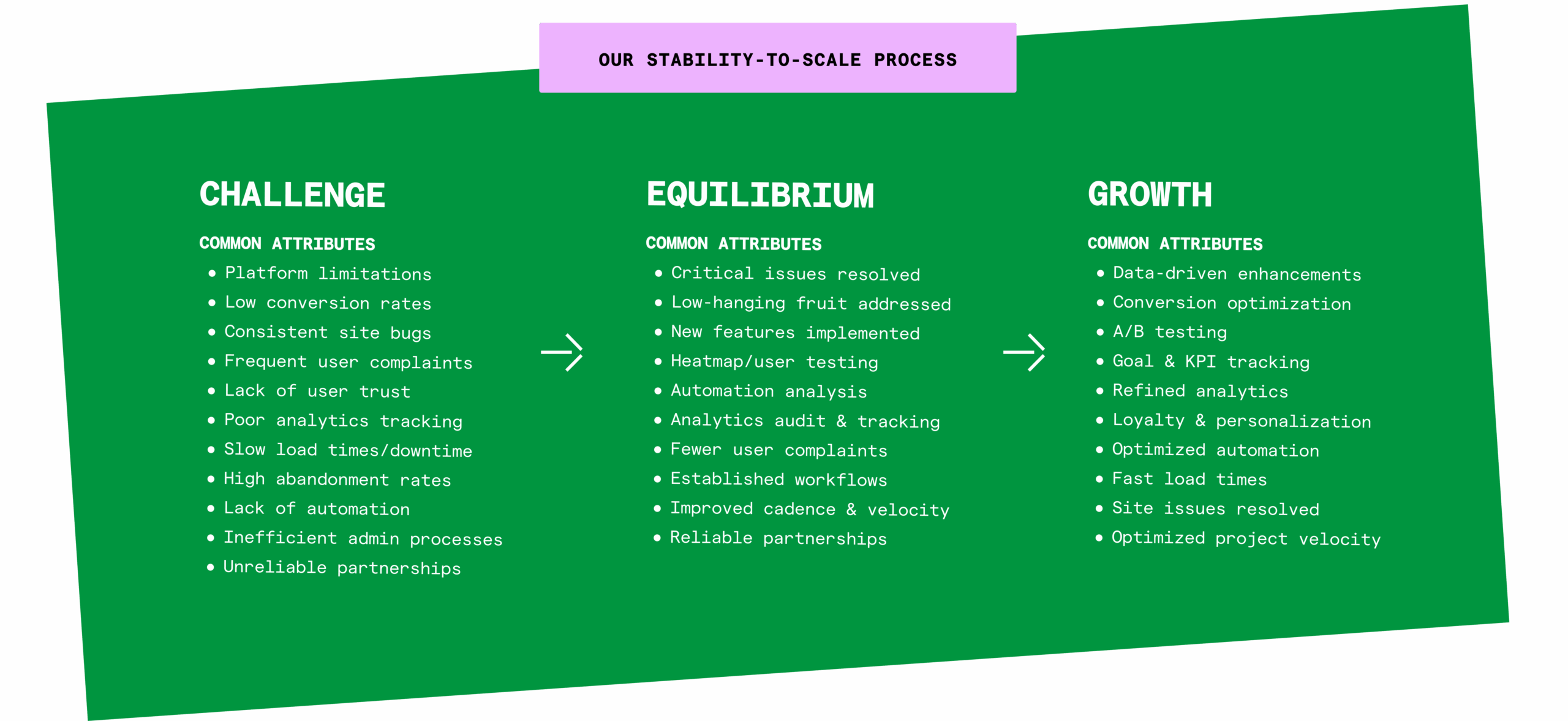
Our Stability-to-Scale Process provides a framework for this decision. Brands in Challenge phase often need iPaaS for rapid stabilization. They’re firefighting and don’t have time for lengthy custom development projects. Brands in Equilibrium can consider hybrid approaches that balance speed with customization. Brands in Growth phase might benefit from optimized custom middleware for competitive advantage.
We have deep expertise in both approaches because we’ve rescued brands from failing custom integrations and helped brands migrate from iPaaS platforms that couldn’t meet their needs. We understand the real-world trade-offs beyond vendor marketing promises.
Our Strategic Technical Roadmaps evaluate not just ‘custom vs iPaaS’ but the entire integration architecture: which platforms you’re connecting, what data needs to flow where, what business logic is required, how your team will maintain it, and what your growth trajectory means for scalability requirements.
When we build custom middleware, we address the maintenance burden that makes most custom integrations fail over time. Proper monitoring, documentation, retry logic, and alerts are built in from the start. We don’t create technical debt, we prevent it.
We can also configure and optimize iPaaS platforms to handle complex ecommerce workflows, building custom logic where needed to extend beyond standard connector capabilities. We know how to push these platforms to their limits without breaking them.
Our Long-Term Development Partnerships mean you’re not locked into a single approach forever. We can start with iPaaS for rapid deployment, then migrate specific integrations to custom code as needs evolve, or vice versa. We act as an extension of your team, which means we’re incentivized to recommend the approach that makes your operations more stable and scalable long-term.
Making the Decision: A Framework for Ecommerce Leaders
Start by auditing your current integration situation. What systems need to connect? What’s breaking or causing problems? How much time does your team spend maintaining integrations vs building features? What integration needs are on the roadmap for the next 12 months?
Assess your technical resources honestly. Do you have developers with integration expertise who can build and maintain custom middleware? Is your team already at capacity? Can you hire specialized talent if needed? Or do you need a solution that works with limited technical resources?
Consider your business stage using our framework. Challenge phase brands need rapid stabilization and should lean toward iPaaS or managed solutions. Equilibrium phase brands can consider hybrid approaches that balance speed with customization. Growth phase brands may benefit from optimized custom middleware for competitive differentiation.
Calculate realistic total cost of ownership for both approaches over 3-5 years, including all the hidden costs of maintenance, opportunity cost, and risk. This analysis will reveal whether the ‘cheaper’ option is actually cheaper over time when you factor in developer hours and business impact.
Evaluate the risk of integration failures during critical business periods. Custom middleware without robust monitoring is high-risk during BFCM and peak sales periods. iPaaS platforms typically have better reliability and automatic retry logic built in, but they introduce their own dependencies.
Don’t make this decision based solely on cost. Factor in speed-to-market, team bandwidth, operational stability, and how integrations support your competitive differentiation. The fastest solution isn’t always the best if it can’t scale with your growth.
Consider getting expert help for this evaluation. Our Strategic Technical Roadmap process can diagnose your specific situation, provide unbiased guidance on custom vs iPaaS vs hybrid approaches, and create an implementation plan that aligns with your business stage and resources.
Remember that this isn’t a permanent decision. You can start with one approach and evolve to another as your business grows and your needs change, especially if you work with a partner who can guide that transition without creating technical debt.
The question isn’t which tool to choose, it’s whether your integration approach can handle the pressure of growth without creating the kind of technical debt that turns development into a bottleneck. Get that architecture right, and the tactical choice of custom vs iPaaS becomes much clearer.