
If You’re a Speciality Retailer, Stop Copying Mass-Market DTC Playbooks
Conversion Rate Optimization has become table stakes for ecommerce, but most advice treats all online stores the same. Generic checklists tell you to add trust badges, simplify checkout, and run A/B tests, as if your $20M specialty retail brand has the same conversion challenges as a Shopify dropshipper selling phone cases.
It doesn’t. And that mismatch is why so many sophisticated specialty retailers are stuck.
At your scale, the problem usually isn’t awareness of CRO best practices. You’ve read the playbooks. You’ve probably hired someone to execute them. The issue is that generic tactics were built for mass-market buying behavior, not for customers making considered, premium purchases in a category they care deeply about. Applying the wrong framework doesn’t just fail to move the needle. It can actively undermine the brand equity you’ve spent years building.
But here’s what we’ve found working with dozens of 8-figure specialty retailers: even the right framework fails when the foundation beneath it is broken. You can’t run meaningful A/B tests on a platform with inconsistent tracking. You can’t personalize effectively with a messy product data architecture. You can’t fix conversion at the top of the funnel when checkout is held together with patches from three different development teams. Most brands hitting a CRO ceiling aren’t lacking tactics.They’re trying to optimize on top of infrastructure that can’t support it. That means solving the CRO problem is really two jobs: diagnosing what’s actually limiting performance, then building programs calibrated to your brand positioning and customer base. This is what that process looks like.
Why Generic CRO Advice Fails Specialty Retailers
CRO is the process of increasing the percentage of visitors who complete a desired action but for specialty retailers, the conversion journey is fundamentally different from mass-market ecommerce, and the gap widens as your brand matures.
Your customers face different barriers before buying. They’re navigating longer consideration cycles for premium items, evaluating artisanal products they can’t physically inspect, and making decisions that reflect their taste and expertise. The tactics designed to accelerate impulse purchases actively conflict with how these customers shop.

This is where 8-figure specialty brands most often go wrong: copying CRO tactics from mass-market DTC brands (aggressive popups, countdown timers, frequent discounting) that work for impulse purchases but alienate customers who value expertise and exclusivity. A client we worked with, Fast Growing Trees, is selling, you guessed it, trees. And they aren’t competing on urgency. Their customers are making considered purchases rooted in growing knowledge and genuine enthusiasm for the category. Pressure tactics don’t convert them. They just signal that your brand doesn’t understand them.
Effective CRO at your level requires understanding the specific decision-making process your customer goes through. Are they discovering your product category for the first time and need substantial education? Are they experienced buyers comparing your artisanal offering against commodity alternatives and looking for validation? Are they returning customers who need reassurance about seasonal availability before committing? Each scenario requires a different optimization strategy, and none of them are addressed by generic advice.
Before You Spend Another Dollar on CRO, Run This Readiness Check
Before layering in new optimization initiatives, it’s worth an honest assessment of whether your technical foundation can actually support them. At 8-figures, this is less about whether your site is broken and more about whether it’s architected for sophisticated, systematic testing.
Our Stability-to-Scale framework categorizes sites into three phases. In Challenge, CRO is essentially impossible, the team is firefighting bugs, tracking is unreliable, and any optimization effort gets swallowed by instability. In Equilibrium, tests run and checkout works, but wins don’t compound. Each improvement exists in isolation because the underlying architecture can’t support systematic learning. In Growth, the foundation is solid enough that optimization becomes a flywheel: tests inform each other, personalization works, and gains accumulate over time.
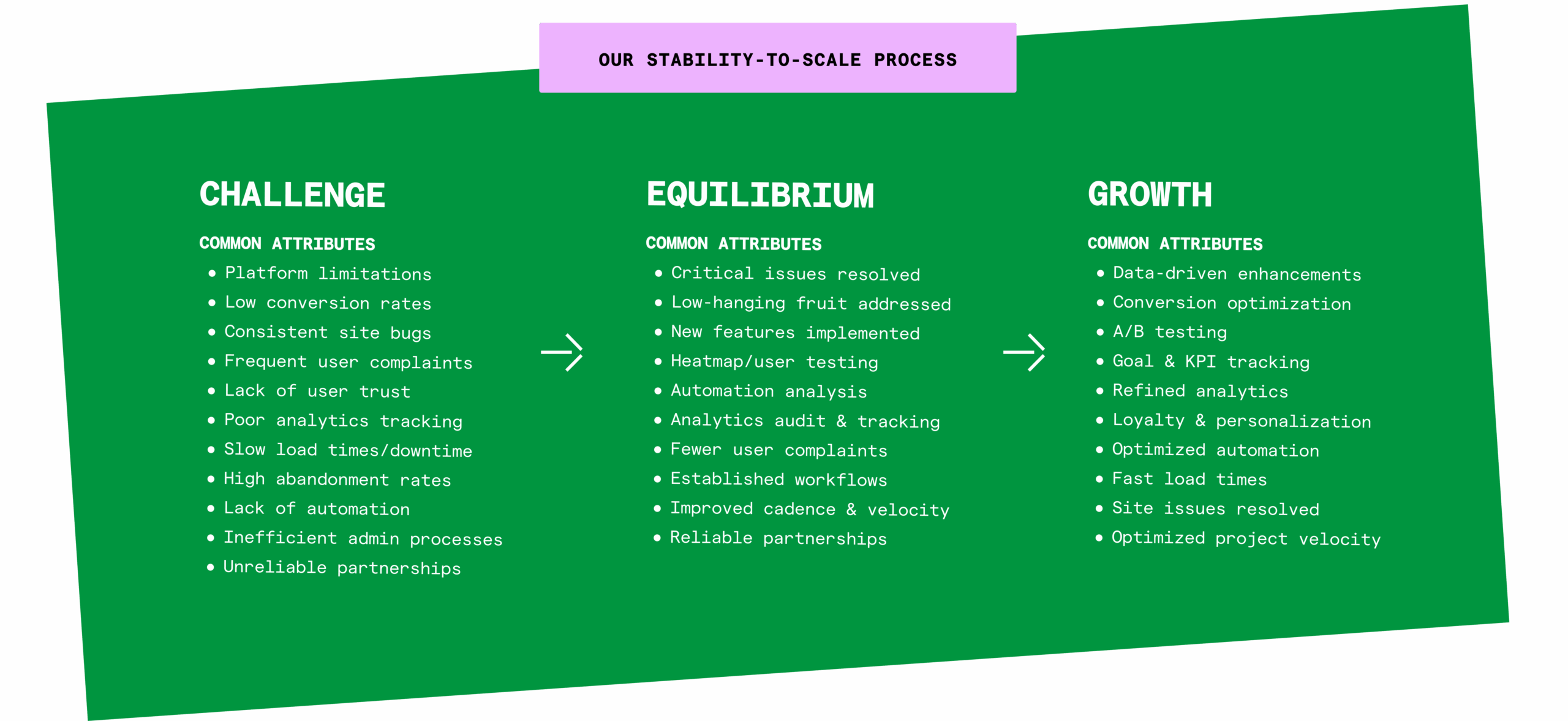
Most 8-figure specialty retailers we work with aren’t in Challenge mode. They’re in Equilibrium or early Growth: stable enough to operate confidently, but not yet structured to run the kind of systematic optimization that compounds over time. The symptoms look like: conversion rates that have plateaued despite healthy traffic, A/B tests that produce inconclusive results because tracking isn’t clean, personalization tools that underperform because product data isn’t consistent enough to power them, and CRO initiatives that require significant dev involvement every time because the codebase wasn’t built for iteration.
If any of this sounds familiar, more tactics aren’t the answer yet. The leverage is in resolving the structural constraints first, then building the optimization program on top of a foundation that can actually support it.
Why Your CRO Tests Won’t Compound Until You Fix the Data Layer
Site speed has an outsized impact on specialty retail because your pages are inherently heavier. High-quality product imagery, video, detailed storytelling content, all of it is necessary for the brand experience, and all of it creates performance risk if not carefully optimized. Every one-second delay in load time reduces conversions by 7%, and on mobile the impact is worse.
Mobile optimization deserves particular scrutiny at your scale. Specialty retail sites often prioritize desktop because that’s how leadership experiences the brand but more than 60% of ecommerce traffic comes from mobile. If your mobile product pages bury the Add to Cart button under storytelling content, or your checkout forms are difficult to complete on a phone, you’re losing a significant portion of your addressable market regardless of how good your desktop experience is.
Data architecture is where many 8-figure specialty retailers have a quiet problem. If your product data structure is inconsistent (variants organized differently across product lines, attributes missing or stored in non-standard fields, metafields added ad hoc over time) personalization engines and recommendation algorithms can’t function properly, and your analytics won’t give you clean signal to optimize against. This is especially common in brands that have grown quickly or migrated platforms without a full data restructure.
Checkout flow integrity is non-negotiable before investing in upstream optimization. If customers encounter errors at payment, confusing shipping options, or friction around account creation, every dollar spent on CRO above the fold is partially wasted. Stabilizing checkout first consistently delivers the highest ROI because it stops the revenue leakage that’s already happening.
Codebase quality compounds over time. Years of patches, conflicting plugins, and development work from multiple vendors creates slow load times, browser compatibility issues, and a codebase that breaks when you try to add new features. At your scale, a code audit isn’t a luxury, it’s due diligence before any serious optimization investment.
What a Product Page Looks Like When You Stop Optimizing for Impulse
Product pages for specialty retailers have to accomplish something genuinely difficult: educate customers on what makes the product worth the premium while simultaneously reducing friction and encouraging purchase. Generic CRO advice optimizes for one or the other. The craft is doing both.
Imagery needs to work harder than lifestyle photography. For a specialty nursery selling Japanese maples, customers need to see the tree’s form across seasons, close-ups of bark texture, and mature specimens in real landscape settings. For a premium kitchen goods brand, they need to understand how the product performs, not just how it photographs. Specialty customers can’t touch or taste online. Visuals have to close that gap.
Product descriptions should follow a deliberate hierarchy: lead with the unique value proposition and what differentiates this from commodity alternatives, follow with practical specifications, then go deeper into provenance and storytelling for the engaged reader. A heritage seed company might open with “heirloom tomato variety dating to 1885,” move to growing specifications, then offer the variety’s history and flavor profile for the customer who wants the full picture. This structure serves browsers and researchers simultaneously.
Trust signals matter more at premium price points, and they need to be calibrated to your audience. Certifications, press mentions, and detailed customer reviews build credibility but aggressive sales language undermines it. Specialty customers are sophisticated. They can tell the difference between earned authority and manufactured urgency, and they’ll discount your brand accordingly if you conflate the two.
Authentic scarcity is a legitimate conversion tool. If a product is genuinely limited edition or seasonal, communicate that clearly and specifically. But manufactured countdown timers are a brand liability. A serious plant collector or specialty food enthusiast knows the difference between real scarcity and fabricated pressure, and the latter signals that you don’t respect their intelligence.
Cross-selling should feel like curation, not an algorithm. Rather than generic “you may also like” recommendations, frame suggestions as “pairs well with,” “complete the set,” or “from the same grower.” Specialty customers value expert guidance and want to feel like they’re discovering something, not being pushed toward a higher cart value.
Build Trust Without Cheapening Your Brand
For premium products where customers can’t physically inspect what they’re buying, reviews that describe quality, texture, performance, or outcome are doing significant conversion work. Particularly for first-time buyers taking a risk on an unfamiliar brand.
Photo and video reviews have particular power in specialty categories. A specialty coffee roaster benefits more from real customer photos of their morning setup than from another polished product shot. Authenticity in social proof outperforms production value.
Testimonials should be outcome-focused, not satisfaction-focused. “Great product!” does little for a hesitant buyer. “This fertilizer doubled my orchid blooms in one season” speaks directly to the result the next customer is hoping to achieve. Specialty customers want evidence that the premium is worth it, and specific outcomes deliver that evidence.
Certifications, sourcing transparency, and production detail justify premium pricing in ways that marketing copy alone cannot. If your products are organic, sustainably sourced, or made through a distinctive process, surface that information prominently. Specialty customers often choose your brand specifically because of these values. Don’t make them hunt for the confirmation.
Press mentions and industry recognition build credibility with risk-averse buyers who are unfamiliar with your brand. Feature relevant coverage prominently. Specialty customers are often deeply engaged with niche publications and communities, and a mention from a trusted source in their world carries real weight.
Streamline Checkout Without Losing Premium Feel
Cart abandonment is the single biggest conversion leak in ecommerce, and for specialty retailers the primary culprits are unexpected shipping costs, complicated checkout flows, and anxiety about return policies for premium or perishable products.
Shipping cost transparency should happen on the product page, not at checkout. Specialty customers are already making a premium price decision. Discovering significant shipping fees at the final step feels like bait-and-switch and it damages trust at the worst possible moment.
Simplify forms without cutting corners on security signaling. Prioritize guest checkout, minimize required fields, use address autocomplete, and preserve payment information securely for returning customers. Every unnecessary field is abandonment risk, and at your traffic volumes, that risk has a measurable dollar cost.
Trust signals at checkout need to address the specific concerns of premium buyers: clear return policy, responsive customer service access, and payment security. These customers are spending more than they would elsewhere and need final reassurance that they’re protected if something doesn’t meet expectations.
Cart recovery emails need to maintain brand voice under pressure. Automated recovery sequences that resort to desperate language or deep discounts train customers to abandon intentionally and wait for the offer. Instead, use recovery emails to provide genuinely useful information (care instructions, sizing guidance, a reminder of your return policy) that addresses the real hesitation without discounting your brand.
Personalize Like a Curator, Not an Algorithm
Personalization for specialty retail should feel like expert curation, not behavioral targeting. The framing matters: “recommended for you based on browsing history” feels algorithmic and impersonal. “If you’re growing in Zone 5, these varieties perform reliably” feels like advice from someone who knows the category.
Segment by customer lifecycle stage with sophistication. New visitors need education and brand credibility. Lead with product guides, maker stories, and reviews that establish authority. Returning visitors who haven’t converted need a different kind of reassurance. Surface your return policy, customer service availability, and specific product details that address common hesitations. Past customers need convenience and discovery. Make reorder seamless, surface complementary products intelligently, and offer subscription options where relevant.
Geographic targeting can solve conversion problems before they start. If you have location-specific inventory, shipping restrictions, or climate-dependent product relevance, show customers what’s actually available and appropriate for them rather than surfacing products they can’t purchase or that won’t perform in their environment. A native plant nursery prioritizing species suited to the visitor’s hardiness zone is doing genuine service, not just optimization.
Traffic source segmentation matters more than most specialty retailers realize. Customers arriving from Instagram or an influencer referral often arrive with pre-built interest and respond well to social proof and community. Customers from organic search are often in research mode and need more context about what differentiates your products. The same landing page experience is suboptimal for both.
Why Your A/B Tests Keep Coming Back Inconclusive
Prioritize high-traffic, high-impact pages and elements first. Test product page changes, hero image types on your homepage, checkout form structure, and trust signal placement. These changes have the highest potential impact and the best chance of reaching significance within a reasonable timeframe.
Measure beyond immediate conversion rate. For specialty retail, average order value, time on page, scroll depth, and returning customer rate are often as important as top-line conversion. A test that slightly lowers immediate conversion but meaningfully increases AOV or repeat purchase rate is a win and you won’t see it if you’re only watching one metric.
Treat negative results as data. If a change didn’t perform, analyze why specifically. Did it introduce confusion? Conflict with brand expectations? Create new friction in a part of the journey you didn’t anticipate? Those insights shape the next test and prevent you from cycling through the same failed approaches.
Tailor Tactics to Your Vertical
Horticulture and nursery retailers face a distinctive combination of seasonal constraints, shipping complexity with live products, and customers with deep category knowledge. Success requires clear hardiness zone information surfaced at the right moment, seasonal availability calendars that set expectations accurately, care instructions that demonstrate expertise, and shipping policies that honestly address weather delays and live plant risks. A specialty orchid grower and a vegetable seed company are both serving passionate gardeners, but their customers’ hesitations and decision criteria are meaningfully different.
Food and beverage specialty retailers must compensate for the absence of sensory experience. Product descriptions need to evoke taste and texture in specific terms, customer reviews that describe flavor profiles do conversion work that marketing copy can’t, and certification and sourcing transparency are often the deciding factors for values-driven buyers.
Fashion and apparel specialty brands need to solve fit at scale. Detailed size guides with real measurements, fit videos across different body types, customer review filtering by size and fit, and generous return policies with free return shipping collectively reduce the perceived risk that makes premium apparel a harder online conversion than commodity alternatives.
Home goods and furniture specialty retailers are working with longer consideration cycles and higher stakes decisions. Customers need to visualize products in their space. 360-degree views, styled lifestyle imagery, precise dimension specifications, and AR visualization tools all reduce the uncertainty that drives abandonment on high-investment purchases.
Luxury and artisan brands face the most acute tension between optimization and brand integrity. Aggressive CRO tactics cheapen positioning in ways that are difficult to recover from. The optimization focus should be on storytelling that earns the price point, curation that feels expert rather than algorithmic, and customer service access that reinforces the premium experience at every touchpoint.
When to Get Outside Help
At 8-figures, the question usually isn’t whether to invest in CRO, it’s whether your current approach is structured to produce compounding results or just incremental experiments.
Internal teams running occasional A/B tests without a systematic process, consistent analytics infrastructure, and dedicated development capacity tend to produce inconsistent results. Not because the team lacks capability, but because CRO done well is a continuous discipline, not a series of projects.
Signs that external expertise adds value at your scale: conversion rates that have plateaued despite healthy traffic and a capable internal team, previous optimization efforts that didn’t stick because implementation was deprioritized, analytics that don’t give you clean enough signal to make confident decisions, or a backlog of CRO recommendations that never make it into the development queue.
Most CRO agencies will audit your site and hand you a prioritized list of recommendations. That’s useful, but it’s not sufficient. If the underlying technical foundation has constraints — inconsistent data architecture, a codebase that makes iteration slow, tracking gaps — those recommendations will underperform, and you’ll be back to square one when the engagement ends.
We diagnose before we prescribe, starting with a Strategic Technical Roadmap that assesses whether your platform, codebase, and data infrastructure can actually support the optimization program you want to run. We resolve structural constraints first so that when we build the CRO program, the results compound rather than erode.
Our Conversion Optimization Program is built specifically for specialty retailers who are past the firefighting stage and ready to grow systematically. It combines conversion audits, A/B testing, analytics reviews, and UX design into a continuous improvement cycle — each initiative tracked for measurable ROI, with implementation-ready reporting so your development team always knows exactly what to build and why.
Long-term partnerships deliver better CRO results than one-off engagements because institutional knowledge compounds. An agency that understands your customer, your seasonal patterns, your brand constraints, and your development capacity makes better optimization decisions than one starting from scratch every engagement. Our Development Partnership model keeps that knowledge inside the relationship. Building, testing, and iterating continuously so gains accumulate rather than stall at the recommendation stage.
The ROI calculation is straightforward at your scale. If systematic optimization moves your conversion rate from 2% to 2.2% (a 10% relative improvement) that’s 10% more revenue from your existing traffic. For an 8-figure specialty retailer, that incremental revenue clears agency investment within months, making a well-structured CRO program one of the highest-return growth investments available.