
Shopify Plus B2B Strategy: A Strategic Decision Framework for 8 & 9-Figure Brands
Most Shopify Plus B2B strategy content focuses on feature setup and technical configuration. While these tactical elements matter, this approach creates three critical blind spots: it assumes Shopify Plus is the right fit for your business, ignores the operational planning required for successful B2B implementation, and treats all wholesale operations as having identical needs.
For 8 & 9-figure ecommerce brands, these decisions don’t show up as minor oversights. They show up as OPEX leakage, gross margin erosion, and platform constraints that quietly undermine both DTC and B2B performance.
The brands that succeed with B2B treat platform selection and implementation as a strategic infrastructure decision, not a feature rollout. They evaluate platform fit before committing to development, design operational workflows before configuring systems, and plan for long-term complexity rather than immediate functionality.
This framework starts with the strategic questions that determine whether Shopify Plus B2B aligns with your business requirements, then covers implementation best practices for brands where the platform is indeed the right choice.
Command C’s Strategic Technical Roadmap for Shopify Plus B2B
Why Most B2B Implementations Fail: The Planning Problem
The majority of B2B ecommerce projects that struggle can trace their issues back to a single decision point: jumping directly into platform configuration without validating that the chosen platform can handle the operational complexity of the business.
Most brands approach B2B implementation backwards. They choose Shopify Plus because they’re already using it for DTC, then try to force their wholesale requirements into the platform’s capabilities. When native features fall short, teams layer on apps and custom development, accumulating technical debt that introduces fragile integrations, rising maintenance costs, and scaling constraints.
The planning problem manifests in three ways. First, teams underestimate the operational changes required for B2B success. Adding wholesale customers isn’t just about different pricing; it requires new workflows for credit approvals, custom quoting, order approvals, and customer relationship management. Second, integration requirements are more complex than anticipated. B2B operations typically require deeper connections to ERP systems, accounting platforms, and fulfillment providers than DTC operations. Third, feature gaps emerge after launch when business-critical functionality like advanced pricing rules or multi-location inventory allocation proves inadequate.
Command C’s Strategic Technical Roadmap process prevents these expensive failures by diagnosing business requirements, evaluating platform capabilities, and mapping operational workflows before any development begins. We’ve guided dozens of 8 & 9-figure brands through this evaluation, and the pattern is consistent: thorough upfront planning eliminates costly platform switches and operational disruptions later.
Evaluating Platform Fit Before Implementation
Not every established ecommerce brand should use Shopify Plus for B2B operations. Complex pricing structures, heavy ERP integration requirements, multi-location inventory management, or specialized fulfillment workflows may require different platforms or hybrid approaches.
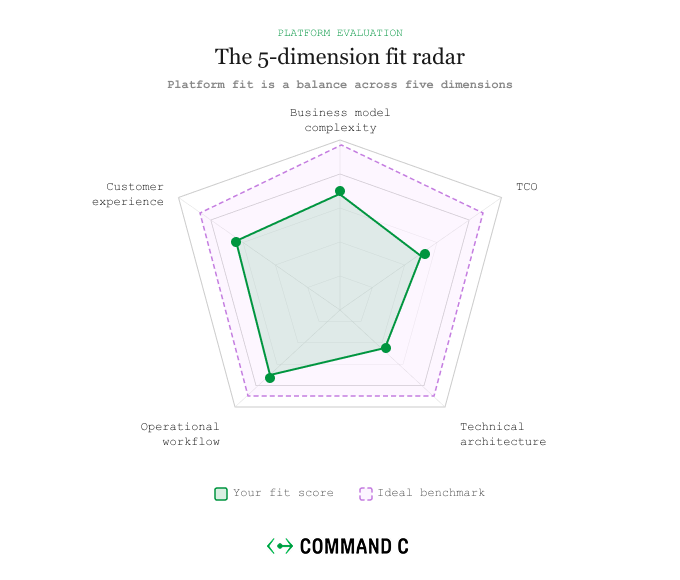
Our discovery process evaluates five critical dimensions. Business model complexity determines whether your pricing, customer segmentation, and operational requirements fit within Shopify Plus B2B’s feature set or require a more flexible platform. This is not just a feature evaluation, it’s a Total Cost of Ownership (TCO) assessment, helping quantify the long-term ROI of Shopify Plus versus alternatives like BigCommerce while reducing risk to your DTC revenue. Technical architecture assessment examines your existing tech stack, integration requirements, and development resources to identify potential friction points. Operational workflow analysis maps your current B2B processes against platform capabilities to determine where gaps exist and what custom development might be required. Customer experience requirements ensure that your B2B buyers will have the functionality they need for efficient ordering and account management. Growth trajectory planning evaluates whether the platform can scale with your wholesale ambitions over 24-36 months.
The evaluation process reveals when Shopify Plus B2B is the right choice and when alternative approaches provide better long-term value. For brands with straightforward wholesale requirements and existing Shopify Plus infrastructure, native B2B functionality often provides the fastest path to market. For operations with complex pricing matrices, multi-tier approval processes, or specialized customer portals, other platforms or custom solutions may be more appropriate.
Most importantly, this evaluation identifies integration touchpoints with ERP systems, 3PL providers, accounting platforms, and customer data systems before development begins. Understanding these dependencies early prevents the data fragmentation and workflow disruptions that derail B2B launches.
Strategic Migration and Implementation Approach
When Shopify Plus B2B is the right platform choice, successful implementation requires a parallel build approach that protects DTC performance while introducing wholesale capabilities. We treat this as a Zero-Risk Deployment, ensuring checkout stability, site speed, and conversion performance remain intact for high-volume retail customers while B2B is layered in.
The migration process begins with comprehensive data structuring. Customer accounts, product catalogs, and pricing information must be organized to support both business models seamlessly. We consolidate customer data to prevent duplicate accounts, structure product information to support B2B-specific requirements like bulk pricing and quantity rules, and implement pricing logic that serves both customer types without conflicts.
Parallel builds allow continuous DTC operations during B2B implementation. We develop and test wholesale functionality in staging environments, validate integrations with existing systems, and ensure that new features don’t impact current performance. The cutover process is designed to be invisible to DTC customers while providing immediate functionality for wholesale users.
Integration architecture receives particular attention because B2B operations typically require deeper system connections than DTC. Real-time inventory synchronization prevents overselling across channels, automated order routing ensures fulfillment efficiency, and unified customer data provides complete visibility into account relationships and purchase history.
Our enterprise-grade migration process includes comprehensive testing of pricing logic, payment terms, customer approval workflows, and integration touchpoints before launch. This systematic approach eliminates the surprises that often emerge when B2B functionality goes live without proper validation.
Long-Term Optimization and Partnership Model
B2B operations evolve significantly as wholesale relationships mature and order volumes grow. Initial platform configurations rarely handle the operational complexity that develops over 12-24 months as customer requirements become more sophisticated and internal processes need optimization.
This evolution creates ongoing development needs that are best handled through strategic partnerships rather than project-based engagements. Command C’s monthly retainer model provides dedicated project management, strategic guidance, and technical resources that scale with your B2B growth.
Our ongoing partnerships focus on conversion rate optimization for B2B user flows, operational workflow streamlining to reduce administrative overhead, and advanced feature implementation as wholesale needs become more complex. This might include custom pricing engines for volume discounts, approval processes for large orders, automated reorder systems, or specialized customer portals that provide self-service functionality.
The partnership model ensures that development resources are available when market opportunities arise or operational bottlenecks need resolution. Instead of waiting for project scoping and vendor selection, established clients can implement strategic improvements quickly and maintain competitive advantages in their wholesale markets.
Most importantly, ongoing partnerships provide institutional knowledge about your business that enables strategic recommendations rather than just tactical implementations. Our teams understand your operational workflows, customer requirements, and growth trajectory, allowing us to suggest optimizations that align with business objectives rather than just technical capabilities.
Essential Shopify Plus B2B Features and Setup
Company Profiles and Customer Management
Shopify Plus B2B transforms individual customer accounts into comprehensive company profiles that support multiple buyers, locations, and role-based permissions within a single wholesale relationship. This structural change eliminates the confusion of managing separate accounts for each buyer within an organization while providing the granular control needed for complex business relationships.

Company profiles serve as the foundation for all B2B functionality. Each company can include multiple locations with distinct shipping preferences, individual buyers with different permission levels, custom payment terms that automatically apply at checkout, and tax exemption settings that flow through to accounting systems. The centralized structure provides complete visibility into account relationships while maintaining the flexibility needed for complex organizational hierarchies.
Customer management becomes streamlined through unified order history that spans all buyers within a company, account notes and communication tracking that provide context for customer service interactions, and role-based permissions that allow companies to control which employees can place orders, view pricing, or access account information.
Reducing the B2B sales team’s administrative burden is one of the most immediate gains. Instead of managing dozens of individual accounts for large wholesale customers, teams work from consolidated company profiles with full relationship visibility. This can eliminate hours of manual account management each week, allowing sales and support teams to focus on revenue-generating activities.
Custom Pricing and Catalog Management
Price lists eliminate the manual quoting processes that create bottlenecks in traditional B2B operations while providing the flexibility needed for customer-specific or volume-based pricing strategies. When wholesale customers log into their accounts, they automatically see their negotiated pricing without requiring sales team intervention or separate quote generation systems.
Catalog customization goes beyond simple pricing to create curated product experiences for different customer segments. Companies can be assigned specific catalogs that show only relevant products, hide pricing from non-authenticated users, or feature special product collections that align with their purchasing patterns. This targeted approach improves the buying experience while protecting pricing information and product availability data.
Quantity rules and minimum order requirements can be configured per product or customer to align with operational constraints and profitability requirements. These automated controls prevent orders that don’t meet business criteria while providing clear guidance to customers about ordering requirements.
The catalog management system supports complex product relationships including bundled products, variant-specific pricing, and category-based quantity rules. This flexibility allows brands to implement sophisticated pricing strategies without custom development while maintaining the operational control needed for profitable wholesale relationships.
Advanced catalog features include seasonal pricing adjustments, promotional campaigns targeted to specific customer segments, and inventory allocation rules that reserve stock for priority customers. These capabilities transform static product listings into dynamic merchandising tools that drive both customer satisfaction and business performance.
Payment Terms and Invoicing Integration
Native support for extended payment terms eliminates the complexity of managing separate invoicing systems while maintaining the financial controls needed for credit-based wholesale relationships. Net 30, 60, or 90 payment terms are handled automatically with secure, trackable workflows that integrate with accounting systems.
Purchase order integration captures PO numbers at checkout and flows this data through to ERP and accounting systems for seamless reconciliation. Beyond eliminating manual entry, this improves financial visibility, reduces DSO (Days Sales Outstanding), and increases cash flow velocity, stabilizing working capital for 8 & 9-figure operations.
Credit management functionality includes automated payment reminders, overdue notifications, and credit limit enforcement that prevents orders from exceeding approved credit lines. These financial controls operate in the background, maintaining positive customer relationships while protecting business interests.
The payment terms system supports multiple scenarios including split payments across terms, early payment discounts, and customer-specific credit limits. Integration with accounting platforms ensures that all payment activity is recorded accurately and financial reporting remains consistent across systems.
Advanced payment features include automated collections workflows, dispute management processes, and financial reporting that provides visibility into accounts receivable performance. This comprehensive approach transforms payment terms from administrative burden into strategic advantage.
Advanced B2B Strategies and Customization Options
Operational Workflow Optimization
Successful B2B implementation requires fundamentally redesigning internal processes around the different requirements of wholesale versus retail customers. The administrative workflows that support individual consumers don’t scale to business buyers who place larger orders, require approval processes, and need detailed account management.
Quote generation workflows must evolve from manual processes to automated systems that provide instant pricing for complex orders while maintaining approval requirements for special circumstances. Order approval processes need clear escalation paths and automated notifications that keep large orders moving without creating bottlenecks. Inventory allocation requires rules that balance DTC availability with wholesale commitments while preventing stockouts across channels.
Customer communication workflows become more sophisticated with B2B operations. Account managers need visibility into order status, shipping updates, and account performance. Customers require self-service access to order history, invoicing information, and account details. Marketing communications must be segmented by customer type to ensure relevant messaging and appropriate promotional offers.
We help reduce the cost to serve by documenting current workflows, identifying inefficiencies, and implementing automation that removes manual effort from B2B operations. The goal is not just functional B2B capability, but a shift from white-glove manual service to a self-service growth engine that scales without increasing overhead.
Administrative efficiency improvements typically include automated reorder systems for frequently purchased items, bulk ordering interfaces that handle large product lists, approval workflows that route orders based on dollar amounts or customer criteria, and reporting systems that provide visibility into wholesale performance metrics.
Integration Architecture for Unified Operations
B2B success depends on establishing a single source of truth across Shopify Plus and core operational systems. When data is fragmented between platforms like NetSuite or Sage, it creates “inventory ghosts”—units that appear available but are already committed elsewhere. This leads to overselling, fulfillment delays, and breakdowns in trust across both wholesale and DTC channels.
Integration architecture must support real-time inventory synchronization across all sales channels to prevent overselling and stockout situations. Order data must flow automatically to fulfillment systems with appropriate routing based on customer type, shipping requirements, and inventory location. Customer data needs unified storage that provides complete relationship visibility across sales, marketing, and customer service teams.
Our integration expertise ensures that B2B functionality enhances rather than complicates existing operational workflows. ERP connections maintain accurate inventory data and automated order processing. 3PL integrations route wholesale orders through appropriate fulfillment workflows. Accounting system connections ensure accurate financial reporting and accounts receivable management.
The integration architecture also supports advanced operational requirements including multi-location inventory management for businesses with multiple warehouses, international B2B sales with appropriate tax and shipping calculations, drop-ship vendor management for products fulfilled by suppliers, and customer-specific fulfillment requirements for special handling or packaging needs.
Future-proofing these integrations requires understanding business growth trajectory and operational expansion plans. The architecture must accommodate additional sales channels, new fulfillment providers, expanded product catalogs, and increased transaction volumes without requiring complete rebuilds.
Performance and Conversion Optimization
B2B buyers have fundamentally different expectations than DTC customers. They prioritize efficiency over discovery, need bulk ordering capabilities over individual product browsing, and require account management tools over promotional features. Optimizing B2B storefronts requires understanding these different priorities and designing experiences accordingly.
Conversion optimization for B2B focuses on reducing friction in the buying process rather than encouraging exploration or impulse purchases. Quick order forms allow customers to enter SKUs and quantities directly without navigating product pages. Saved product lists enable easy reordering of frequently purchased items. One-click reordering functionality eliminates repetitive order entry for routine purchases.
Navigation optimization prioritizes product search and filtering over browsing experiences. Advanced search functionality includes SKU-based search, product specification filtering, and category-specific faceted search. Product information displays focus on specifications, availability, and pricing rather than lifestyle imagery or emotional appeals.
Our conversion optimization approach includes comprehensive analytics implementation to track B2B-specific metrics including average order value by customer type, reorder frequency, search-to-order conversion rates, and customer acquisition costs. These metrics provide insight into B2B performance that differs significantly from DTC analytics.
Advanced optimization features include personalized product recommendations based on purchase history, dynamic pricing displays that show volume discounts, inventory availability notifications for key customers, and account-specific dashboards that provide order status and account information.
Alternative B2B Platforms and When to Consider Them
BigCommerce B2B Edition
BigCommerce B2B Edition offers enterprise-focused native B2B capabilities including sophisticated customer groups, advanced price lists, comprehensive quote management, and detailed customer segmentation. The platform provides stronger out-of-the-box B2B functionality than most alternatives and requires less custom development for complex wholesale requirements.
The platform excels in scenarios requiring complex product configurations, advanced pricing rules that exceed Shopify Plus capabilities, or heavy customization requirements that demand greater platform flexibility. BigCommerce’s open API architecture and extensive customization options make it suitable for businesses with specialized workflow requirements or unique customer portal needs.
However, BigCommerce B2B Edition comes with higher total cost of ownership and longer implementation timelines. The platform requires more technical resources for setup and maintenance, has a steeper learning curve for non-technical users, and typically involves more expensive ongoing development costs. These factors make it less attractive for brands prioritizing speed to market or those already invested in Shopify Plus infrastructure.
The decision point typically comes down to complexity versus efficiency. Brands with straightforward wholesale requirements benefit from Shopify Plus B2B’s faster implementation and lower maintenance requirements. Businesses with complex operational needs may justify BigCommerce’s higher costs through superior native functionality and customization flexibility.
Magento Commerce B2B
Magento Commerce B2B provides the most comprehensive and flexible platform for complex requirements, with advanced pricing rules, multi-site management, and deep customer segmentation. However, this flexibility comes with longer implementation timelines. For directors operating on quarterly goals, the decision becomes a Time-to-Value calculation, whether the additional capability justifies the opportunity cost of a 9–12 month build compared to a 2–3 month Shopify Plus launch.
The platform’s flexibility makes it the preferred choice for enterprises with highly specialized B2B workflow requirements, complex pricing structures that exceed other platforms’ capabilities, or significant custom development resources available for ongoing platform management. Magento’s extensive feature set can handle virtually any B2B scenario with sufficient development investment.
However, Magento Commerce B2B requires significant ongoing technical resources and development expertise that make it cost-prohibitive for most 8 & 9-figure brands. Implementation timelines are typically 6-12 months longer than other platforms, ongoing maintenance requires dedicated technical teams, and customization complexity can create fragile systems that are expensive to maintain and difficult to upgrade.
The platform is best reserved for enterprises with dedicated ecommerce technical teams, complex B2B requirements that justify significant platform investment, and operational budgets that can support ongoing development and maintenance costs.
When Shopify Plus B2B Is the Right Choice
Shopify Plus B2B provides the optimal balance of functionality, implementation speed, and operational efficiency for established DTC brands looking to add wholesale capabilities. The platform offers the fastest path to market for businesses receiving wholesale inquiries who need to validate B2B demand before making major platform investments.
The platform excels for brands already operating on Shopify Plus who want to add B2B functionality without operational disruption or platform migration costs. Native integration with existing DTC operations ensures unified inventory management, consolidated customer data, and streamlined administrative workflows.
Shopify Plus B2B is particularly well-suited for businesses with straightforward wholesale requirements including standard pricing structures, basic customer segmentation needs, and integration requirements that align with the platform’s native capabilities. The combination of functional adequacy and operational efficiency makes it the preferred choice for brands prioritizing market entry speed over customization depth.
Command C’s Strategic Technical Roadmap process provides the evaluation framework needed to determine when Shopify Plus B2B aligns with business requirements versus when alternative platforms provide better long-term value. This diagnostic approach ensures platform decisions are based on operational realities rather than feature lists or marketing claims.
For brands considering B2B expansion, the platform decision is one of the most critical factors determining implementation success. Our roadmap process eliminates the guesswork by providing clear evaluation criteria and actionable recommendations based on your specific business requirements and operational complexity.
The next step is understanding where your B2B requirements fit within the platform landscape. Rather than assuming any particular platform is the right choice, start with a strategic evaluation that aligns technical capabilities with business objectives.
Ready to evaluate whether Shopify Plus B2B is right for your wholesale expansion? Our Strategic Technical Roadmap process provides the diagnostic framework you need to make confident platform decisions and avoid expensive implementation mistakes.