
White Flower Farm
is bringing a legendary nursery into a modern ecommerce architecture
Migrating a Legacy, Multi-Platform Nursery Business to Shopify Plus
The Challenge
White Flower Farm has spent decades building a reputation as a premier destination for perennials, bulbs, and garden gifts, a business built on horticultural expertise as much as retail savvy. But their ecommerce operation was running on infrastructure that hadn’t kept pace with the business. Product, inventory, and order logic were distributed across a legacy ERP system, a legacy ecommerce platform, and their operations and fulfillment system. Every workflow that touched more than one of these systems added complexity and risk.
The stakes were higher than a standard replatform. White Flower Farm sells living products. Shipping windows depend on hardiness zones, seasonal readiness, and weather, and getting that messaging wrong doesn’t just hurt conversion, it damages plants and customer trust. On top of the horticultural complexity, White Flower Farm was building out a growing gifting business, spanning individual consumer gifting, high-volume corporate orders, and white-glove concierge service, that their existing platform had evolved to support with a set of complex constraints via workarounds and heavy customization..
Command C was brought in to migrate White Flower Farm’s ecommerce site onto Shopify Plus and, just as importantly, to help simplify the underlying architecture: collapsing several disconnected systems into a clean, direct relationship between the storefront and operations.
“When Title Nine decided to move our ecommerce site and retail POS to Shopify, we met with several highly regarded implementers. We needed a partner who could lay out a clear plan, help us make informed decisions at every stage, and deliver for our business. From our first conversations, it was clear that Command C had the expertise and experience we sought and would be the right partner for us.
The most valuable part of the engagement with Command C was the Strategic Technical Roadmap. It produced a clear, detailed SOW that became our blueprint, and it’s the main reason we stayed on time and on budget. We replaced both Salesforce Commerce Cloud and our POS in a full omnichannel cutover, moved our integration layer from Boomi to Ekyam, and went live on October 6, 2026, exactly on our target date. Command C’s data first approach stood out and they maintained that philosophy throughout our project, which has ensured that our resulting website and POS platform can effectively grow and scale with our always evolving business.Command C’s communication was always timely, clear and to the point. That allowed us to make good decisions quickly and ensured everyone’s time, theirs and ours, was well spent. The team was also invested in our success, which was evident in how closely they worked with the other partners on the project, including Layers, Ekyam and Listrak.
They’re also great people to work with. We couldn’t have picked a better partner for our Shopify migration, and I’d recommend Command C to any business taking on a complex technical project.
”
– Leslie Street, COO
The Solution
Simplifying a Fragmented Architecture
The core of this project was never just a platform swap. We worked closely with White Flower Farm’s internal team and operations partners to shift the source of truth for product, inventory, and order data away from the legacy ERP and ecommerce systems and onto a direct, purpose-built connection between Shopify Plus and their fulfillment platform. That system now owns product core data, inventory levels, and order scheduling, factoring in hardiness zone, availability, customer-requested ship dates, and even weather. Shopify handles the customer experience, checkout, and order edits. We defined clear, bidirectional workflows: product and inventory data flows in, orders flow out to fulfillment, and shipment tracking flows back into Shopify.
Custom Hardiness Zone Intelligence
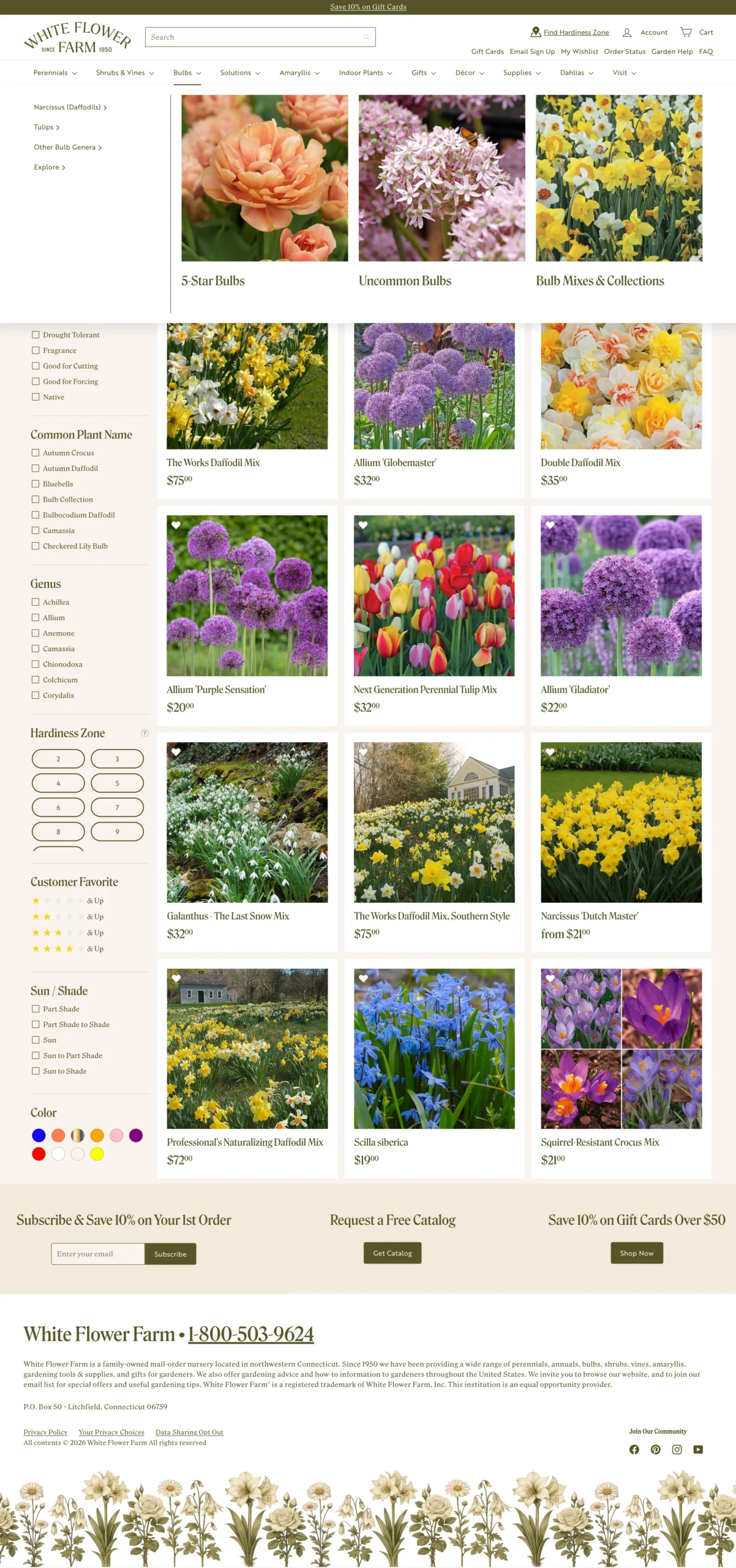
Zone-based shopping is central to how White Flower Farm’s customers buy. We built a custom zip-to-zone lookup application, hosted externally, that returns a USDA growing zone for any customer-provided zip code. That zone data flows sitewide: products are labeled in or out of the customer’s zone on both product grids and PDPs, with exceptions built in for non-botanical items like vases and decor, and special handling for annuals.
Shipping messaging itself is dynamically generated from a combination of product readiness date, customer zone, and current date, deliberately calibrated toward general language like “ships in August” rather than false precision. Quarantine-restricted products trigger PDP warnings and checkout-level shipping profile restrictions, and customers can optionally select a requested delivery window that’s passed through to their fulfillment system.
Product Data Architecture for a Complex, Living Catalog
Few ecommerce catalogs need to represent what White Flower Farm’s does. We designed a product type structure spanning standard own-name products, kitted collections (garden mixes and gift sets that are assembled and inventoried on the operations side but presented as individual products on the frontend), subscription-eligible products, gift certificates, and event listings. Seasonality, the “same” product that is available in multiple seasons, is accounted for in both product structure and customer messaging. Shared botanical content, plant type, landscape use, genus, is managed through a reusable content structure and referenced dynamically across the catalog rather than duplicated per product.
Gifting, Reimagined
Gifting was one of White Flower Farm’s clearest growth opportunities, and is one of the hardest to support well in any platform. We built out a full gifting experience covering consumer gifting with multiple delivery addresses that does not require external checkout, a robust corporate and bulk gifting flow with admin controls built for scale, and a concierge workflow that gives White Flower Farm’s customer support team the tools to manage white-glove, high-touch gift orders directly.
Search and Merchandising
For product discovery, we moved beyond Shopify’s native search and filtering to a more advanced solution capable of indexing the custom growing-condition and hardiness-zone data that powers White Flower Farm’s catalog, since that data isn’t natively exposed to standard Shopify search. That same solution also powers restock notifications, tied to product data so that only items both sold out and confirmed for next season surface the option, along with more sophisticated merchandising and product recommendations.
Communications, Content, and Reviews
We connected White Flower Farm’s storefront to their existing email and SMS marketing platform for transactional and lifecycle communication, including hardiness-zone-aware messaging and support for supplemental communications. Reviews are integrated and keyed to Shopify product data. We also rebuilt White Flower Farm’s Garden Help content, blog posts, how-to-grow articles, and growing guides, migrating existing content into a unified Shopify content structure, and built automation so that catalog requests flow directly into their addressing, fulfillment and tracking systems.
Comprehensive, Carefully Governed Data Migration
With several legacy systems in play, migration required a clearly defined division of labor. Command C led the migration of products, collections, order history, customers, gift certificates, reviews, non-product content and 301 redirects, collaborating with the White Flower Farm team and various external partners via a plan mapped in a shared responsibility matrix so nothing fell through the cracks. Structured product and order data migration was handled with proven bulk import tooling, while close collaboration with operations system teams ensured that the operations system’s kitting and inventory logic translated cleanly into Shopify’s data model.
The Results
White Flower Farm is now live on Shopify Plus, having successfully replaced a fragmented, multi-system architecture with a clean, direct integration between the storefront and operations. The new platform gives White Flower Farm a single, coherent source of truth for products and inventory, a dramatically simplified operational footprint, and a foundation purpose-built for the complexity of selling living products at scale.
- Consolidated Architecture: A multi-system operational footprint was reduced to a direct, purpose-built connection between Shopify Plus and fulfillment, cutting the overhead and risk that came with maintaining logic across disconnected platforms.
- Zone-Aware Shopping Experience: Custom hardiness zone logic is now built into navigation, product discovery, and PDP messaging sitewide, giving customers accurate, zone-specific guidance at every step.
- A Modern Gifting Platform: Consumer, corporate, and concierge gifting are fully supported, positioning White Flower Farm to grow this segment of the business meaningfully.
- A Scalable Product Data Foundation: A restructured product data model, complete with reusable botanical content and consolidated bundle groups, gives White Flower Farm a catalog structure that can grow without requiring another architectural overhaul.
Looking Ahead
White Flower Farm and Command C have already scoped the next phase of enhancements: deeper marketing automation to expand communication touchpoints between order and shipment, more advanced promotional tooling, enhancements to reporting and tracking. As with our other long-term partnerships, this migration marks the start of an evolving platform relationship, not the end of one.