
Title Nine
is outfitting women who lead, risk, and own it
Unifying Title Nine’s Ecommerce and Retail Stores on Shopify Plus and POS Pro
A complex migration from Salesforce Commerce Cloud and NetSuite SCIS to Shopify Plus and Shopify POS Pro, creating a more connected, flexible foundation for growth.
The Challenge
Title Nine has spent decades building a loyal following of women who run, climb, swim, and play hard. Their business spans a busy online store and 14 retail locations, and for years those two channels ran on separate systems: Salesforce Commerce Cloud powered ecommerce, NetSuite SCIS handled point of sale, and an integration layer stitched both back to NetSuite.
That distributed architecture had become expensive to maintain and slow to change. Executing mission-critical operations meant touching several platforms, retail staff worked directly inside the ERP, and product data moved through a custom process that required significant manual effort. Every new feature had to be reconciled across systems that were never designed to share a single view of products, customers, and orders.
Title Nine needed to consolidate. The goal was one commerce platform for both channels, a simpler connection to NetSuite, and a better experience for shoppers and store teams alike. All of it had to come together on a four-month timeline to launch ahead of the holiday season.
Project Goals
- Platform Migration: Move ecommerce from Salesforce Commerce Cloud to Shopify Plus, taking full advantage of native functionality and Shopify’s ecosystem for long-term sustainability and ease of administration.
- Retail Unification: Transition all 14 retail locations from NetSuite SCIS to Shopify POS Pro, running on the same Shopify instance as the online store.
- Simplified Architecture: Reduce the number of platforms required to run mission-critical operations, with a single, consistent integration between Shopify and NetSuite.
- Seamless Omnichannel Experience: Create a simple, consistent experience for customers whether they shop online or in store.
- Performance and Usability: Optimize the new storefront for speed and ease of use.
- Automated Data Transition: Migrate products, customers, orders, and related functions with as little manual effort as possible for either team.
- On-Time, On-Budget Delivery: Launch on schedule in October without disrupting the business.
“Command C’s communication was always timely, clear and to the point. That allowed us to make good decisions quickly and ensured everyone’s time, theirs and ours, was well spent. The team was also invested in our success, which was evident in how closely they worked with the other partners on the project. We couldn’t have picked a better partner for our Shopify migration, and I’d recommend Command C to any business taking on a complex technical project.”
– Leslie Street, COO
Our Plan
The project began with our Strategic Technical Roadmap, a discovery process that documented every system, data flow, and requirement before development started. That work produced a clear current-state and future-state map of Title Nine’s technology stack and a plan that balanced speed to market with long-term extensibility. We selected a proven Shopify theme as the foundation, which kept design overhead low and let us focus custom development on the features that make Title Nine’s experience distinctive.
One Platform for Online and In-Store
The heart of this project was unification. Each of Title Nine’s 14 retail stores was set up as a Shopify POS Pro location alongside the online store, so products, customers, orders, and inventory now live in one place. Store staff no longer need to work in NetSuite directly. Product information and customer profiles are available right in the POS app on an iPad.
We planned the timeline around early product setup and dedicated in-store testing windows. The retail experience now supports:
- Ship and carry-out items in the same transaction, plus ship-from-store fulfillment
- Location-agnostic returns and exchanges, so a customer can return an online order in any store
- Saved and retrieved customer carts, full customer data visibility, and offline selling capability
- Physical and digital gift cards that work across both channels
A Cleaner Connection to NetSuite
The previous setup required multiple connections between commerce systems and the ERP. The new architecture has one primary connection: Shopify Plus and POS Pro to NetSuite. Because the Shopify instance as a whole is integrated, retail sales flow to NetSuite through the same path as online orders. We defined clear data directionality so each system does what it does best:
- Products and inventory: NetSuite is the source of truth for product existence, core product details, and inventory levels, which flow into Shopify. Rich merchandising content is managed directly in Shopify. Through automations and administrative overrides, Title Nine is able to carefully control the presentation of product availability on the frontend.
- Orders: Orders placed online or in store flow from Shopify to NetSuite for fulfillment.
- Payment capture and tracking: Shipment tracking posts back to Shopify, fulfillment triggers payment capture, and the capture returns to NetSuite to create the cash sale.
- Customers: Customer records sync bidirectionally between Shopify and NetSuite.
Command C provided Shopify-side support throughout the connector configuration, with special attention to data mapping and an end-to-end test strategy covering ecommerce, retail POS, fulfillment, and returns.
A Product Data Structure Built for Merchandising
A successful replatform depends on getting product data right. We designed a structure using product and variant metafields, metaobjects, tags, and product types that drives both frontend display and automated collections, then documented it in a living reference for Title Nine’s team. A few areas required creative solutions:
- Visually accurate swatches: Title Nine’s catalog includes products that share a color name but look completely different. Neither native swatch tooling nor the theme could handle that, so we built a variant-level swatch structure that displays the right visual every time.
- Combined listings: Variations of the same product across sizing, length, sleeve type and color/pattern on Title Nine’s site can be presented as variants of a single product page, preserving a familiar shopping pattern.
- Outlet in the same store: We created a template scheme that runs Outlet inside the main Shopify instance, with its own colors, logo, header, and navigation. Outlet and full-price items share one cart, and Outlet products carry a clear badge on listing pages, product pages, and in cart.
- Dynamic breadcrumbs: Breadcrumbs generate from URL structure and navigation hierarchy, falling back to a mapped collection by product type so every product page shows a meaningful trail.
Product Pages Built for Confident Purchases
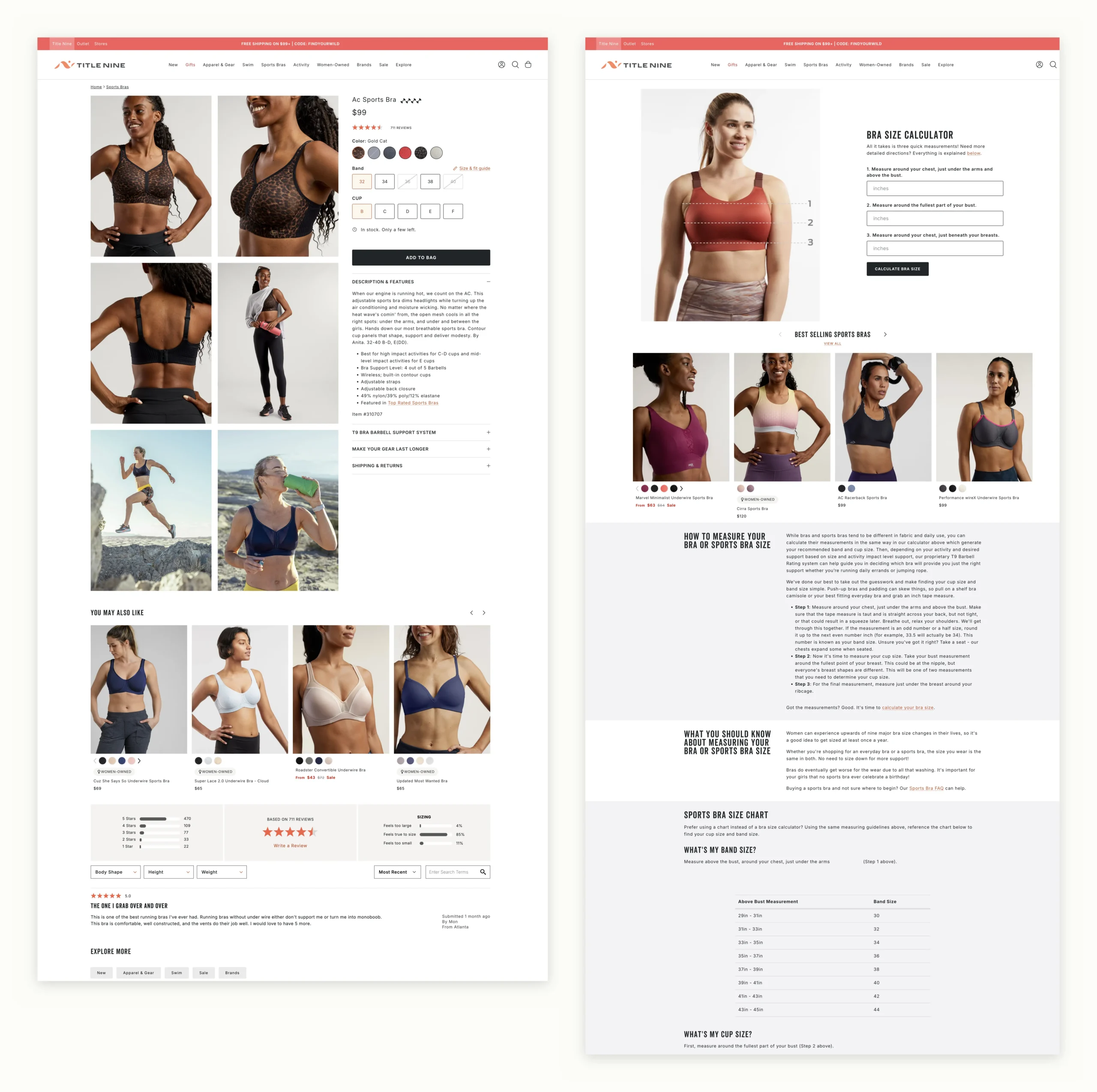
Activewear shoppers want to know exactly how a product will perform before they buy. We extended the theme’s product page with variant-aware media, pricing, and availability, along with features specific to Title Nine’s catalog:
- Barbell impact ratings: Sports bras display Title Nine’s signature barbell icons, with a tooltip and a detail drawer explaining the impact level.
- Smart content assembly: Accordions combine product-specific details such as care, benefits, and expert testimonials with shared content like shipping and returns, managed once and referenced everywhere.
- Merchandising controls: Badges such as Women-Owned, urgency messaging, sale pricing tooltips, final sale logic that carries through to cart and order confirmation, and the ability to mark an item unsellable regardless of inventory count.
- Reviews: Ratings and full reviews keyed to Shopify products.
Fit and Discovery Tools
Finding the right fit is one of the biggest hurdles in women’s activewear, so we built tools that help customers narrow their options with confidence:
- Bra Fit Calculator: A custom tool that takes three measurements and returns a recommended bra size, supported by fit guidance content.
- Swim Finder/Bottoms Finder: A visual, multi-select section that lets shoppers choose the swim styles and features they want and apply them instantly as filters.
- Enhanced collection pages: A left-column category tree for top-level collections, featured category pills, quick filters above the product grid, and dedicated brand collection templates.
We also guided Title Nine through selecting a search and merchandising solution, defining requirements such as variant-level merchandising, per-collection primary image curation, in-grid content/promotions, and semantic search. We then supported setup, configuration, and the product data changes needed to power faceted search and recommendations.
Gifting, Gift Cards, and Promotions
Gift wrap can be added per line item from the cart or flyout cart. Each wrap is tied to the item it covers, so it adjusts or removes itself automatically when that item changes, and fees apply accurately per wrapped item. Gift messages are captured at the order level. Gift cards are available digitally and as physical cards in preset denominations, redeemable both online and in store.
Title Nine’s promotions run on Shopify’s native discount tooling, including automatic and code-based offers, single-use codes, and employee discounts, with bulk code import supported for large campaigns. Benefits for Insighters, Title Nine’s member program, are driven by customer tags so the team can manage them with standard promotion rules.
Returns, Retention, and Customer Service
Title Nine implements a dedicated returns and exchanges platform that works across the online store and POS, so customers get the same self-serve experience no matter where they bought. We also helped connect restock notifications and full cart abandonment messaging (not just checkout abandonment) to Title Nine’s existing email and SMS platform, and consolidated the customer service team’s tooling around Shopify so agents see orders and customer history in one place.
Migration, Analytics, and Launch
We migrated product data directly from Salesforce Commerce Cloud using a structured import format mapped to the new data model, alongside order history, customers, active gift card balances, and reviews mapped to the new catalog. Stories and Guides content moved into customized blog templates with author and tag management, and Command C handled migration of Title Nine’s highest-traffic pages. A full 301 redirect map protected search equity.
On the analytics side, we worked with Title Nine’s analytics partner to implement tag management through Shopify’s Customer Events framework, preserving tracking continuity for marketing and reporting. Before launch, we completed an accessibility audit, recorded training sessions for a private video library, and coordinated delta migrations, POS cutover, and the website launch in a single, carefully sequenced window.
“The most valuable part of the engagement with Command C was the Strategic Technical Roadmap. It produced a clear, detailed SOW that became our blueprint, and it’s the main reason we stayed on time and on budget. We went live exactly on our target date. Command C’s data first approach stood out and they maintained that philosophy throughout our project, which has ensured that our resulting website and POS platform can effectively grow and scale with our always evolving business.”
– Leslie Street, COO
The Results
- One Platform, Two Channels: Title Nine’s online store and 14 retail locations now run on a single Shopify instance, giving customers and staff a consistent view of products, inventory, orders, and customer history.
- Simplified Architecture: A single, clearly defined integration between Shopify and NetSuite replaces a distributed set of systems, reducing operational risk and making troubleshooting simpler.
- Empowered Store Teams: Retail staff work entirely in Shopify POS, with ship-from-store, cross-channel returns, and customer data at their fingertips, and no direct ERP access required.
- Scalable Product Data: A documented data model supports accurate swatches, combined listings, Outlet merchandising, and automated collections as the catalog grows.
- Fit-First Shopping Experience: Custom fit tools, richer product pages, and enhanced collection navigation help customers find the right product with confidence.
- On-Time Delivery: The full ecommerce and POS migration was planned and executed on a four-month timeline to launch ahead of peak season.
Looking Ahead
With ecommerce and retail unified, Title Nine has a foundation built for iteration. The roadmap includes backorder handling with split authorization and capture, a Returns Reduction Sprint once baseline data is in place, an A/B testing framework, wishlist functionality, promo code application in cart, bundles, and continued enhancements to personalization, loyalty, and content management.
Command C is excited to keep building alongside Title Nine as they continue to grow, online and in every store.