
Sylvane
is bringing clean air and water home
Migrating Sylvane.com from a Custom Platform to Shopify Plus While Preserving Mission-Critical Logic
The Challenge
Sylvane’s ecommerce experience wasn’t “just” a storefront — it was the customer-facing layer of a larger operational system. Over time, the custom platform had become harder to sustain and extend, increasing the cost of every change and slowing down iteration.
At the same time, Sylvane needed to preserve mission-critical logic that directly impacts conversion and customer trust: accurate delivery expectations, robust product merchandising, and the operational workflows that sit behind checkout. The migration had to reduce administrative overhead while improving frontend usability and speed, without breaking the underlying business machine.
Project Goals
- Platform Migration: Migrate the ecommerce platform to Shopify Plus, taking full advantage of Shopify’s native capabilities and ecosystem for long-term sustainability and ease of administration.
- Preserve Mission-Critical Logic: Maintain existing mission-critical logic and UX, especially the product data structure and operational requirements that power Sylvane’s experience.
- Optimize Performance & UX: Improve site usability and speed to reduce friction and drive measurable performance gains.
- Operational Integration: Establish and maintain a connection between Shopify Plus and external operations tooling such as NetSuite, plus custom applications for shipment estimation/management and profit estimation.
- Seamless Data Transition: Transition product data and associated ecommerce functions as seamlessly as possible — and automate as much of the transition as possible to minimize manual tasks for both teams.
- On-Time and On-Budget Delivery: Deliver the migration within the agreed timeline and budget.
Our Plan
We developed a plan that balanced speed-to-market with long-term extensibility. To streamline design and maximize development efficiencies, we recommended leveraging a proven Shopify theme as the foundation, allowing us to keep effort focused on the custom logic and UI that truly differentiates Sylvane’s buying experience.
Selected Theme Foundation
The theme we selected as the starting point reduced design overhead while giving Sylvane a stable base of native components that could be extended strategically over time. This approach freed our team to focus on the areas that most impact Sylvane’s customer experience and operations.
Shipping Confidence at Scale: Estimated Ship/Transit Times + Zip-Based Messaging
- Shipping Confidence at Scale: Delivery expectations are central to Sylvane’s customer experience. To preserve Sylvane’s existing shipping logic inside Shopify, we built a theme-to-middleware integration that makes estimated delivery messaging feel native on the PDP and throughout the shopping experience. The theme is integrated with Sylvane’s custom shipping logic for estimation of ship and transit times, allowing the Shopify frontend to set realistic expectations tied to Sylvane’s internal business rules.
- GeoIP Zipcode Detection & Self-Selection: To support localized delivery estimates, we built a customer-facing utility that displays a default zipcode based on GeoIP and allows shoppers to override with a self-selected zip code. Sylvane provides the GeoIP lookup mechanism, while the theme-side utility and UX make it seamless for customers—so delivery expectations are always tailored to the shopper’s actual location.

Product Data Strategy Built for Scale
A successful replatform depends on getting product data right — not only for display, but for filtering, merchandising, and long-term maintainability.
A Structured Data Model Built for Scale
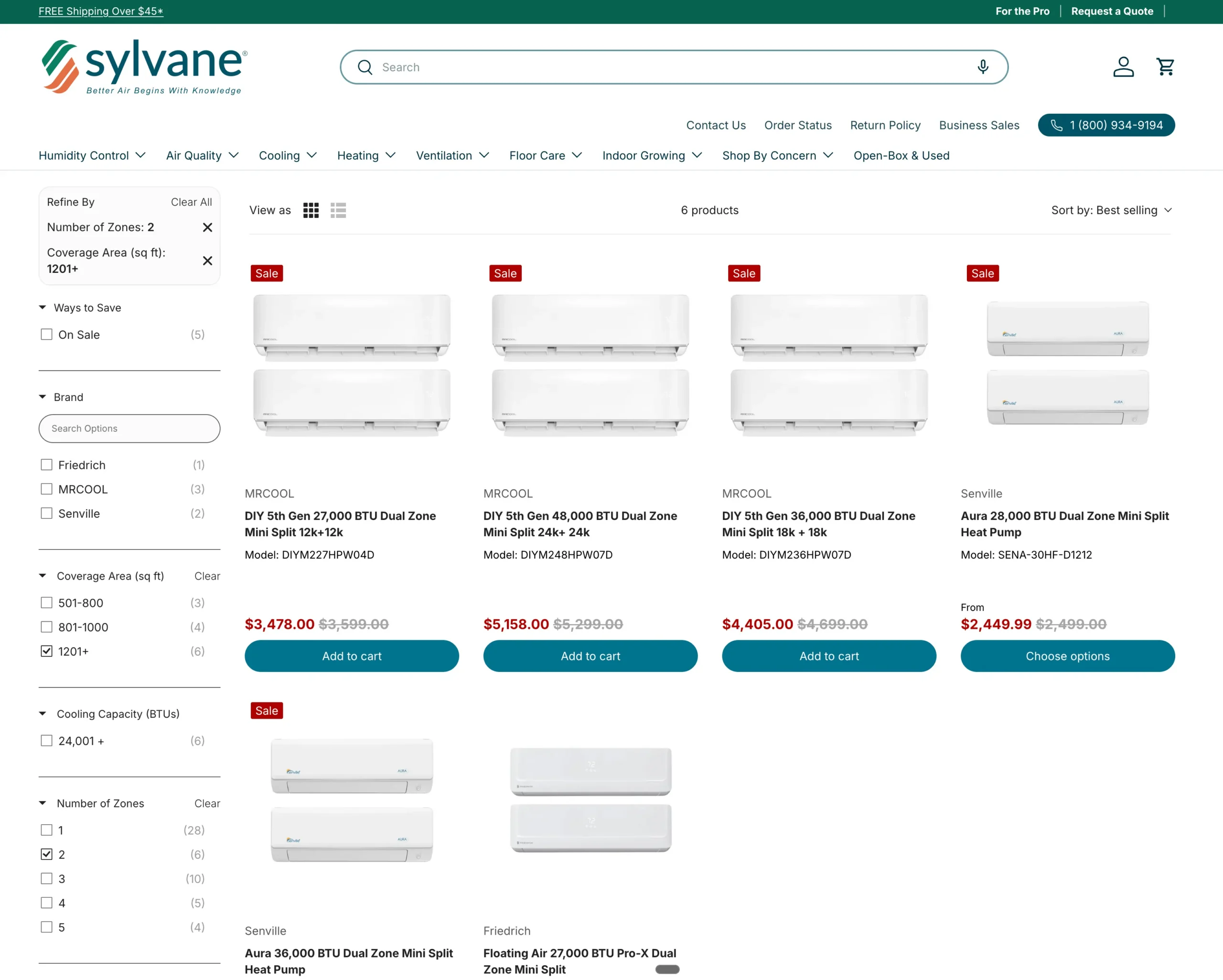
We established a product data strategy that houses an expansive set of attributes at both the product and variant levels, facilitating dynamic display of detailed product specifications, integrated content features and overall product discoverability. We also planned consolidation rules to reduce data sprawl. For example, rolling “Additional Features” into a single list-style metafield, and unifying applicable attributes into a unified type field.
Beyond the standard product-and-variant constructs, product bundling was carefully planned to both improve customer experience and integrate with existing operations and order fulfillment tooling.
A carefully crafted set of collection attributes also allow the theme to automate relationships between content and generate rich collection templates. Dynamic data is available for store staff and marketing teams to leverage while managing content.
Blended B2B/DTC Experience
Sylvane’s scope includes a blended B2B/DTC approach using Shopify B2B. We created Pro users under Shopify’s B2B toolset and using store contextualization to differentiate the presentation layer — such as logo, announcement bar, color scheme, and homepage sections. For onboarding, we built a self-serve signup and upgrade flow leveraging Shopify Forms and Shopify Flow to automate B2B company/customer creation and activation.
Apps and Integrations
We defined a best-fit app stack to support payments, marketing, returns, reviews, migration, and automation — while keeping custom development focused on the areas that truly require it.
Key apps and services include:
Affirm (PDP pay-over-time messaging + payment method enablement), Klaviyo, Loop Returns, BrandLock (hijacked shopper prevention), Matrixify (migration), Shopify Forms, and Shopify Flow.
We also documented broader systems transitions (current → future), including moving from a custom ecommerce platform to Shopify Plus and integrating Boost AI Search & Filter to support a complex set of product attributes via robust filter configurations and smarter product recommendations.
ERP and Data Flows: Shopify + NetSuite Connected
NetSuite sends product existence, core data, and inventory levels to Shopify; Shopify sends orders to NetSuite; and NetSuite sends shipment tracking back to Shopify to trigger Shopify shipment notification emails. This clear separation of concerns reduces risk, simplifies troubleshooting, and keeps both systems doing what they do best.
The Results
- Modern, Scalable Foundation: Following launch, Sylvane now operates on a modern Shopify Plus foundation that reduces platform risk, simplifies administration, and supports long-term scalability.
- Preserved Mission-Critical Shipping Logic: We successfully preserved Sylvane’s mission-critical shipping and delivery logic through a Shopify-to-custom-endpoint integration, including zip-based messaging and precise CarrierService checkout alignment, ensuring continuity in a highly complex operational environment.
- Structured Product Data Model: We implemented a scalable product data model designed for intuitive filtering and merchandising, with clearly defined constraints and consolidation rules to keep the catalog organized and maintainable as it grows.
- Robust ERP Integration: A robust Shopify ↔ NetSuite integration was deployed with clear ownership boundaries and reliable operational flows for orders, inventory, and fulfillment — strengthening backend efficiency and reducing risk.
- Faster, Conversion-Optimized Experience: Beyond the technical migration, the site now runs faster and is supported by a conversion-optimized UX structure designed to reduce friction, improve clarity, and drive measurable performance gains.
Looking Ahead
The migration to Shopify Plus has given Sylvane a sustainable foundation for continued growth, with the flexibility to evolve the customer experience without the drag of legacy platform constraints. With mission-critical logic intact, operations streamlined, and a clean integration path between Shopify and NetSuite, Sylvane is well-positioned to keep iterating, faster and with less risk than before.
“What a BIG and exciting day for us! We’re thrilled with the website and are looking forward to this exciting next chapter. Thank you everyone!”
– Meg Hellerstedt, President, Sylvane